




Type-safe async pub/sub for Rust. One API across RabbitMQ, AWS SNS+SQS, NATS JetStream, Apache Kafka, Redis/Valkey Streams, and an in-process backend.
Guides, examples, and the full walkthrough live at shove.rs. Rustdoc on docs.rs/shove.
- Define a topic once, use it everywhere. Queue names, DLQs, and retries all derive from a single Rust type.
- Retries and DLQs included. Escalating backoff, dead-letter routing, retry budgets, handler timeouts — no glue code.
- Strict per-key ordering when you need it, with pluggable failure policies.
- Autoscaling consumer groups driven by queue depth or consumer lag.
- Switch backends without changing your code. Same topic, same handler, six transports.
- Batch consumption.
BatchConsumerhands your handler up tomax_batch_sizemessages in one call, so a sink's per-call cost (one DB transaction, one HTTP request) is paid per flush instead of per message. Available on all six backends — SQS caps a batch at 10, RabbitMQ atu16::MAX. Measured gains: Performance. - Broadcast subscriptions. Give every process its own ephemeral subscription, so each instance receives every message instead of competing for one queue. Every backend except SQS, where it is excluded permanently: Broadcast.
- Pluggable message codecs. JSON by default; Protobuf, zero-copy SBE, raw bytes, or your own.
- Confluent Schema Registry for Kafka — opt-in encode on publish and decode on consume (Confluent and Redpanda), with subject enforcement.
In-process, no Docker, no credentials:
use serde::{Deserialize, Serialize};
use shove::inmemory::{InMemoryConfig, InMemoryConsumerGroupConfig};
use shove::{
    Broker, ConsumerGroupConfig, InMemory, MessageHandler, MessageMetadata, Outcome,
    TopologyBuilder, define_topic,
};
use std::time::Duration;

#[derive(Debug, Clone, Serialize, Deserialize)]
struct OrderPaid { order_id: String }

define_topic!(Orders, OrderPaid,
    TopologyBuilder::new("orders")
        .hold_queue(Duration::from_secs(5))  // retry with backoff
        .dlq()                               // dead-letter on permanent failure
        .build());

struct Handler;
impl MessageHandler<Orders> for Handler {
    type Context = ();
    async fn handle(&self, msg: OrderPaid, _: MessageMetadata, _: &()) -> Outcome {
        println!("paid: {}", msg.order_id);
        Outcome::Ack
    }
}

#[tokio::main]
async fn main() -> Result<(), shove::ShoveError> {
    use futures::FutureExt as _;

    let broker = Broker::<InMemory>::new(InMemoryConfig::default()).await?;
    broker.topology().declare::<Orders>().await?;

    let publisher = broker.publisher().await?;
    publisher.publish::<Orders>(&OrderPaid { order_id: "ORD-1".into() }).await?;

    let mut group = broker.consumer_group();
    group
        .register::<Orders, _>(
            ConsumerGroupConfig::new(InMemoryConsumerGroupConfig::new(1..=1)),
            || Handler,
        )
        .await?;

    let outcome = group
        .run_until_timeout(tokio::signal::ctrl_c().map(drop), Duration::from_secs(5))
        .await;
    std::process::exit(outcome.exit_code());
}
Swap InMemory for RabbitMq, Sqs, Nats, Kafka, or Redis and the topic and handler stay identical. Per-backend setup: Getting Started.
| Backend | Feature flag | Marker |
|---|---|---|
| RabbitMQ | rabbitmq |
RabbitMq |
| AWS SNS+SQS | aws-sns-sqs |
Sqs |
| NATS JetStream | nats |
Nats |
| Apache Kafka | kafka |
Kafka |
| Redis/Valkey Streams | redis-streams |
Redis |
| In-process | inmemory |
InMemory |
cargo add shove --features <flag>. Need help choosing? Choosing a backend.
Optional add-ons: audit, metrics, kafka-ssl, kafka-gssapi, kafka-msk-iam, kafka-schema-registry, rabbitmq-transactional, pub-aws-sns (SNS publishing on its own, without the SQS consumer), protobuf, sbe, env-config.
Codec details, including the zero-copy SBE path: Codecs.
Configuring the tuning knobs from environment variables: Environment Configuration.
At-least-once by default. Handlers return one of:
Ack— successRetry— delayed retry through hold queues with escalating backoffReject— dead-letter immediatelyDefer— delay without consuming a retry budget
Full semantics: Outcomes & Delivery.
The charts are generated from a committed results document — never hand-copied — and each one carries its own provenance (shove version, generation date, hardware) in the caption. The harness runs against every backend; the currently published document measures all six backends, and a plotted series appears only for a backend the document actually contains. The SQS series measures LocalStack rather than the AWS service and runs a smaller, recorded corpus. See Measurement methodology for what is measured and how.
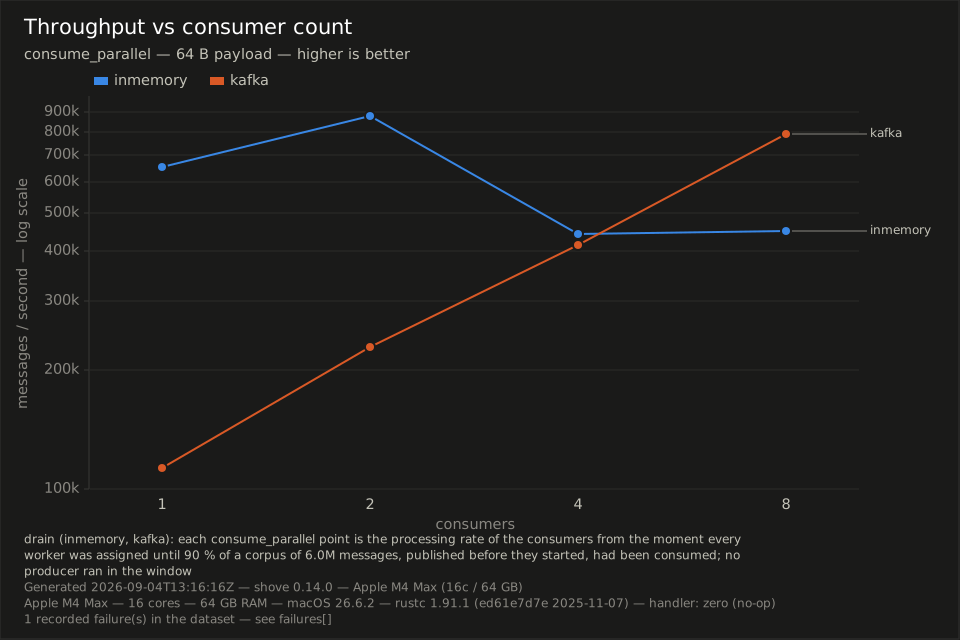
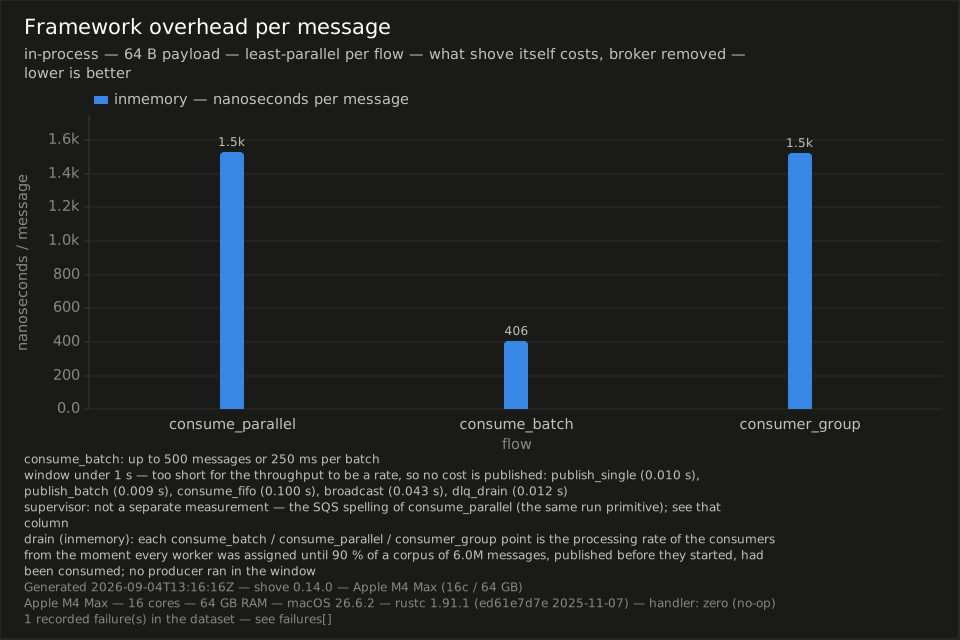
Throughput vs payload size, the cost of sequenced ordering, and dispatch latency
percentiles: Performance. Every published row
comes from one pinned matrix, so a run is reproduced with
scripts/bench.sh <backend> rather than by invoking an example directly; that
script and the chart regeneration are described under
Measurement methodology.
Batch consumption. BatchConsumer hands the handler up to max_batch_size
messages per call, so whatever the handler costs per invocation is paid once per
flush rather than once per message. The table reads the batch flow's drain
ceiling off the same results document: the best cell the charts publish for
each backend and payload, its consumer count, and the ratio to the plain
parallel consumer at that same cell — on SQS, which has no consume_parallel
rows, the comparator is supervisor. Batches are up to 500 messages or 250 ms,
except on SQS, whose API caps a batch at 10. Batching leads most where messages
are small and per-message framework work dominates; at 64 KiB the batch flow is
at most 1.5x the parallel one on every backend, because the cost there is
moving bytes.
| Backend | 64 B (msg/s) | 1 KiB (msg/s) | 64 KiB (msg/s) |
|---|---|---|---|
| In-process | 4.33M (8c), 9.6x parallel | 1.09M (4c), 3.0x | 80k (8c), 1.1x |
| Kafka | 963k (8c), 1.2x | 1.50M (8c), 2.9x | 42k (2c), 1.0x |
| NATS | 101k (8c), 1.1x | 81k (2c), 1.0x | 12k (1c), 1.1x |
| RabbitMQ | 35k (2c), 1.6x | 36k (4c), 1.2x | 31k (4c), 1.3x |
| Redis | 1.29M (8c), 2.1x | 770k (8c), 1.5x | 41k (4c), 1.0x |
| SQS (LocalStack) | 3.2k (8c), 1.1x | 3.3k (8c), 2.5x | 1.9k (8c), 1.1x |
What batching costs. A batch flushes when it reaches max_batch_size or
when max_batch_age expires, whichever comes first, so the rates above are
bought with dispatch latency — and the batch flow is on no latency chart,
because the dispatch-latency family plots the parallel flow only. What the wait
costs depends on which of the two bounds fires. The comparison is the paired
offered-load rungs of the same document: consume_batch against the plain
parallel consumer at the same backend, payload, consumer count and offered rate,
both arms sustaining the rate, every batch row at the defaults
(max_batch_size 500, max_batch_age 250 ms). In the 30 rungs where a
consumer sees under 2,000 msg/s — so 500 messages cannot arrive within 250 ms
and the age bound has to fire — batch dispatch p99 is 250-262 ms in all 30
against 0.14-144 ms for the comparator, and batch is the slower arm in 30 of
30, by 1.7x to 1744x. The ratio spans that much only because the comparator
does: 0.14 ms in-process at 64 B, 143.74 ms on NATS at 64 KiB. The batch side
does not move. Where the batch fills first the wait shrinks with it: across the
other 90 rungs batch p99 runs 6.1-251 ms and is the slower arm in 85, the five
exceptions all in-process rungs where the parallel consumer was itself the
slower one. Pooled, batch loses 115 of the 120. So max_batch_age is
the lever, not batching — lower it to shorten the wait, and pay for it in
smaller batches and less of the amortisation the table measures. SQS contributes
no rung: its batch consumers never kept pace with the paced producer, so its
percentiles there measure backlog rather than dispatch. Every bound is rounded
outward, so no rung falls outside a range stated here.
- Getting Started
- Core concepts
- Guides — retries, sequenced delivery, batch publishing, consumer groups, audit, observability, exactly-once, shutdown, liveness
- Backends
- docs.rs/shove
- Rust 1.91+ (edition 2024)
- Redis 6.2+ or Valkey (when using
redis-streams)
Built and maintained by Zannis Kalampoukis at Synchronicity Labs.