Available on the Chrome web store here: https://chrome.google.com/webstore/detail/google-calendar-gray-week/anbpifeeedchofljolkgmleojmelihom
|
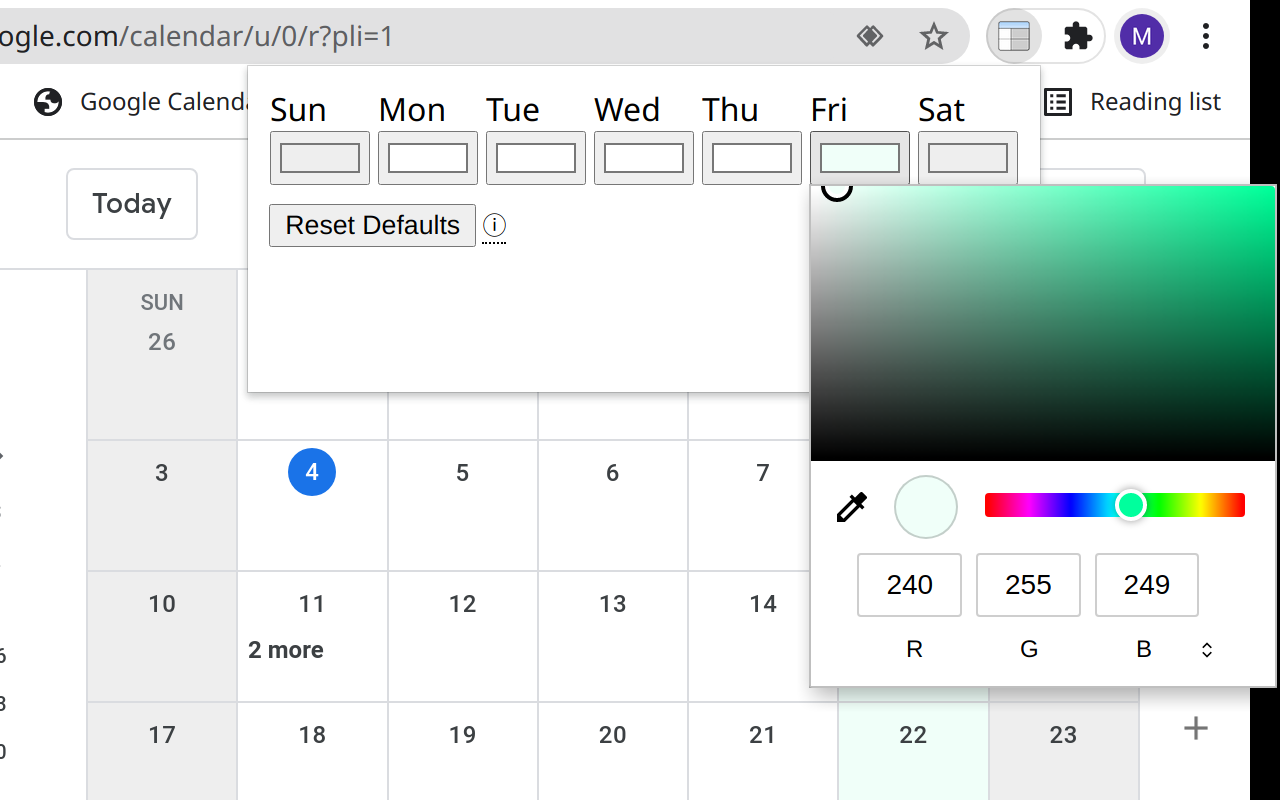
|
This is still very basic, but I've added all the features I'd planned, including a basic color picker. I may add more features if they're requested.
- Not knowing much about JS or Chrome plugins, I borrowed the basic structure for this from https://github.com/imightbeamy/gcal-multical-event-merge
- The only elements that need to be modified are the ones with a
data-datekeyproperty, which basically correspond to a single day (there are a few headers that this colors as well, since I think it looks a little nicer) - The most interesting part of this whole project has been figuring out how the
data-datekeyproperty works. It represents a date as mixed-radix number of the formY*512 + M*32 + D- it uses 1/1/1970 as epoch, so given a
data-datekey = N = Y*512 + M*32 + D", the actual date corresponding toNisM/D/1970+Y - The lowest value of
data-datekey, not surprisingly, is for 1/1/1970, though if you navigate there, you'll see that it hasdata-datekey="33", rather than"0", corresponding toM = 1, D = 1, Y = 0 => 512*0 + 32*1 + 1 = 33 - Dates before 1/1/1970 are represented using a negative
data-datekey. The largest such value12/31/1969 = 512*-1 + 32*12 + 31 = -97 - Moreover, having every radix be a power of 2 means that
data-datekeycan be converted to M/D/Y using only bitwise operators (shifts and masks)
- it uses 1/1/1970 as epoch, so given a
Personal note: I also realized as part of this that dividing by 512 using >>9
actually "fixes" division. If we define the integral quotient idiv(X,Y) to be
largest integer Z such that Z*Y <= X, then idiv(-1, 512) = -1, as returned by
-1>>9 but not by -1/512. If / worked this way as well, then X%Y would
never be negative (but we'd still preserve Y*(X/Y) + (X%Y) = X, which requires
X%Y to be negative given the current convention for /). This would have
avoided a lot of array indexing bugs that I've written in my life