




Your friendly python module
for scientific analysis and visualization of 3d objects.
pip install vedoadditional installation details [click to expand]
- To install the latest dev version of
vedo:
pip install -U git+https://github.com/marcomusy/vedo.git- To install from the conda-forge channel:
conda install -c conda-forge vedofrom vedo import Sphere, show
sphere = Sphere().c("tomato")
show(sphere, axes=1).close()This opens an interactive 3D window with a simple object and axes.
The webpage of the library with documentation is available here.
📌 Need help? Have a question, or wish to ask for a missing feature? Do not hesitate to ask any questions on the image.sc forum or by opening a github issue.
The library includes hundreds of working examples for a wide range of functionalities
working with polygonal meshes and point clouds [click to expand]
- Import meshes from VTK format, STL, Wavefront OBJ, 3DS, Dolfin-XML, Neutral, GMSH, OFF, PCD (PointCloud),
- Export meshes as ASCII or binary to VTK, STL, OBJ, PLY ... formats.
- Analysis tools like Moving Least Squares, mesh morphing and more..
- Tools to visualize and edit meshes (cutting a mesh with another mesh, slicing, normalizing, moving vertex positions, etc..).
- Split mesh based on surface connectivity. Extract the largest connected area.
- Calculate areas, volumes, center of mass, average sizes etc.
- Calculate vertex and face normals, curvatures, feature edges. Fill mesh holes.
- Subdivide faces of a mesh, increasing the number of vertex points. Mesh simplification.
- Coloring and thresholding of meshes based on associated scalar or vectorial data.
- Point-surface operations: find nearest points, determine if a point lies inside or outside of a mesh.
- Create primitive shapes: spheres, arrows, cubes, torus, ellipsoids...
- Generate glyphs (associate a mesh to every vertex of a source mesh).
- Create animations easily by just setting the position of the displayed objects in the 3D scene. Add trailing lines and shadows to moving objects is supported.
- Straightforward support for multiple sync-ed or independent renderers in the same window.
- Registration (alignment) of meshes with different techniques.
- Mesh smoothing.
- Delaunay triangulation in 2D and 3D.
- Generate meshes by joining nearby lines in space.
- Find the closest path from one point to another, traveling along the edges of a mesh.
- Find the intersection of a mesh with lines, planes or other meshes.
- Interpolate scalar and vectorial fields with Radial Basis Functions and Thin Plate Splines.
- Add sliders and buttons to interact with the scene and the individual objects.
- Visualization of tensors.
- Analysis of Point Clouds
- Moving Least Squares smoothing of 2D, 3D and 4D clouds
- Fit lines, planes, spheres and ellipsoids in space
- Identify outliers in a distribution of points
- Decimate a cloud to a uniform distribution.
working with volumetric data and tetrahedral meshes
- Import data from VTK format volumetric TIFF stacks, DICOM, SLC, MHD and more
- Import 2D images as PNG, JPEG, BMP
- Isosurfacing of volumes
- Composite and maximum projection volumetric rendering
- Generate volumetric signed-distance data from an input surface mesh
- Probe volumes with lines and planes
- Generate stream-lines and stream-tubes from vectorial fields
- Slice and crop volumes
- Support for other volumetric structures (structured and grid data)
plotting and histogramming in 2D and 3D
- Polygonal 3D text rendering with Latex-like syntax and unicode characters, with 30 different fonts.
- Fully customizable axis styles
- donut plots and pie charts
- Scatter plots in 2D and 3D
- Surface function plotting
- 1D customizable histograms
- 2D hexagonal histograms
- Polar plots, spherical plots and histogramming
- Draw latex-formatted formulas in the rendering window.
- Quiver, violin, whisker and stream-line plots
- Graphical markers analogous to matplotlib
integration with other libraries
Visualize a polygonal mesh or a volume from a terminal window simply with:
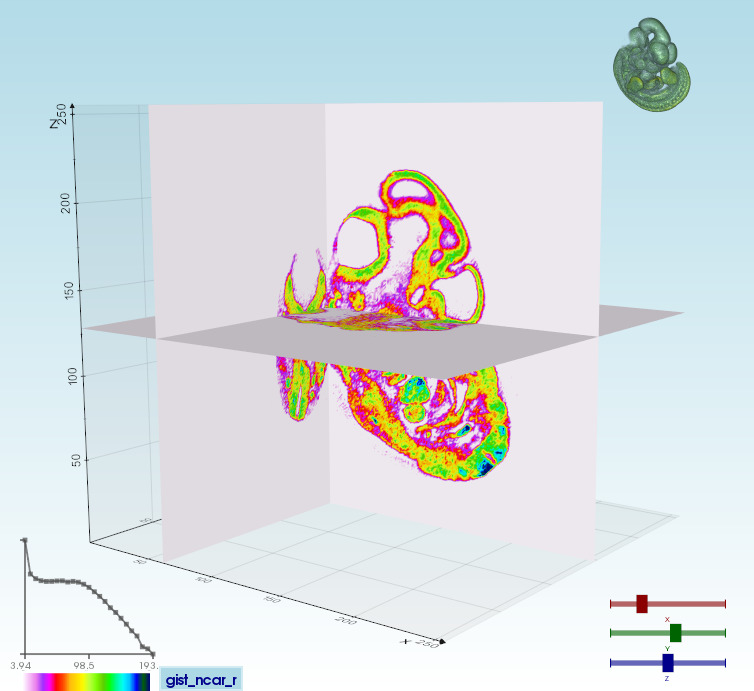
vedo https://vedo.embl.es/examples/data/embryo.tifvolumetric files (slc, tiff, DICOM...) can be visualized in different modes [click to expand]
Volume 3D slicingvedo --slicer embryo.slc |
Ray-castingvedo -g |
2D slicingvedo --slicer2d |
|---|---|---|
 |
 |
 |
Type vedo -h for the complete list of options.
vedo currently includes hundreds of working examples and notebooks.
Run any of the built-in examples. In a terminal type: vedo -r warp2
Check out the example galleries organized by subject here:

Any contributions are greatly appreciated. If you have a suggestion, bugfix, feature, or documentation improvement, please open an issue or submit a pull request.
See CONTRIBUTING.md for contribution guidelines and workflow details.
Scientific publications leveraging vedo:
browse 68 publications using vedo [click to expand]
2026
- L. Aviñó-Esteban et al., "Limblab: pipeline for 3D analysis and visualisation of limb bud gene expression", BMC Bioinformatics 27(1): 6 (2026).
- D. Krsikapa, I. Y. Kim, "Gradient-based optimization of component layout: addressing accessibility and mounting in assembly system design", Journal of Mechanical Design 148(3): 031702 (2026).
2025
- A. Kharlamova et al., "Spatial CAPTCHA: Generatively Benchmarking Spatial Reasoning for Human-Machine Differentiation", arXiv preprint arXiv:2510.03863 (2025).
- J. F. Fuhrmann et al., "Apical extracellular matrix regulates fold morphogenesis in the Drosophila wing disc", bioRxiv 2025-09 (2025).
- B. Li et al., "Three-dimensional spatial transcriptomics at isotropic resolution enabled by generative deep learning", bioRxiv 2025-08 (2025).
- T.-T. Hsu et al., "Shared Alteration of Whole-Brain Connectivity and Olfactory Deficits in Multiple Autism Mouse Models", bioRxiv 2025-02 (2025).
- A. Arrabi et al., "C-arm guidance: A self-supervised approach to automated positioning during stroke thrombectomy", 2025 IEEE 22nd International Symposium on Biomedical Imaging (ISBI).
- L. Aviñó-Esteban, H. Cardona-Blaya, J. Sharpe, "Spatio-temporal reconstruction of gene expression patterns in developing mice", Development 152: DEV204313 (2025), DOI.
- B. Bortolon et al., "GRASPLAT: Enabling dexterous grasping through novel view synthesis", 2025 IEEE/RSJ International Conference on Intelligent Robots and Systems (IROS).
- L. Carreira et al., "Targeted nano-energetic material exploration through active learning algorithm implementation", Energetic Materials Frontiers 6(1): 3-13 (2025).
- M. Chirillo et al., "PyReconstruct: A fully open-source, collaborative successor to Reconstruct", Proceedings of the National Academy of Sciences 122(31): e2505822122 (2025).
- B. Clayton et al., "A facile method to create continuum stochastic sheet-based cellular materials", Additive Manufacturing: 104917 (2025).
- A. Gross et al., "STRESS, an automated geometrical characterization of deformable particles for in vivo measurements of cell and tissue mechanical stresses", Scientific Reports 15(1): 28599 (2025).
- A. Gauvain et al., "HydroModPy: A Python toolbox for deploying catchment-scale shallow groundwater models" (2025).
- K. N. Halwachs et al., "Effects of Stiffness and Degradability on Cardiac Fibroblast Contractility and Extracellular Matrix Secretion in Three-Dimensional Hydrogel Scaffolds", ACS Biomaterials Science & Engineering 11(11): 6521-6533 (2025).
- R. Kliman et al., "Toward an Automated System for Nondestructive Estimation of Plant Biomass", Plant Direct 9(3): e70043 (2025).
- J. Laussu et al., "Deciphering the interplay between biology and physics with a finite element method-implemented vertex organoid model: A tool for the mechanical analysis of cell behavior on a spherical organoid shell", PLOS Computational Biology 21(1): e1012681 (2025).
- M. Mitelut et al., "Continuous monitoring and machine vision reveals that developing gerbils exhibit structured social behaviors prior to the emergence of autonomy", PLoS Biology 23(9): e3003348 (2025).
- J.S. Posada et al., "morphoHeart: A quantitative tool for integrated 3D morphometric analyses of heart and ECM during embryonic development", PLOS Biology 23(1) (2025), DOI.
- A. Prashanth, S. Hathwar, "Comparing the Effectiveness of Deep Learning Models Combined with Loss Functions in Cardiac Segmentation" (2025).
- M. Levin Thomas et al., "Banner cloud formation at the Matterhorn: Measurements versus large-eddy simulations", Journal of the Atmospheric Sciences 82(8): 1661-1675 (2025).
- H. Xu, "A Progressive Interactive Exploration Framework for Vector Field Data Guided by Storylines", 2025 18th International Congress on Image and Signal Processing, BioMedical Engineering and Informatics (CISP-BMEI).
- S. M. Zahedi et al., "Comparative evaluation of neural networks and transfer learning for predicting mechanical properties of 3D-printed bone scaffolds", Macromolecular Materials and Engineering 310(10): e00073 (2025).
2024
- C. Lei et al., "Automatic tooth arrangement with joint features of point and mesh representations via diffusion probabilistic models", Computer Aided Geometric Design 111: 102293 (2024), Code.
- S. Li et al., "MogaNet: Multi-order Gated Aggregation Network", International Conference on Learning Representations (2024).
- J. Cotterell et al., "Cell 3D Positioning by Optical encoding (C3PO) and its application to spatial transcriptomics", bioRxiv 2024.03.12.584578 (2024), DOI.
- D. Galvez Alcantara, "Development of a finite element framework for biological applications" (2024).
- M. Gazziro et al., "Fully Automated Ultra-Personalized 3D Printed Prosthetic Breasts", American Journal of Biomedical Science & Research 20: 128-132 (2024).
- I. G. Gonçalves, J. M. García-Aznar, "Neurorosettes: a novel computational modelling framework to investigate the Homer-Wright rosette formation in neuroblastoma", Computational Particle Mechanics 11(2): 565-577 (2024).
- E. Guiltinan et al., "pySimFrac: A Python library for synthetic fracture generation and analysis", Computers & Geosciences 191: 105665 (2024).
- R. Haase et al., "Benchmarking large language models for bio-image analysis code generation", bioRxiv 2024-04 (2024).
- Y. Jiang, S. L. Bugby, J. E. Lees, "PMST: A custom Python-based Monte Carlo Simulation Tool for research and system development in portable pinhole gamma cameras", Nuclear Instruments and Methods in Physics Research Section A 1061: 169161 (2024).
- D. Li, F. Pucci, M. Rooman, "Prediction of paratope-epitope pairs using convolutional neural networks", International Journal of Molecular Sciences 25(10): 5434 (2024).
- M. Marro, L. Moccozet, D. Vernez, "A numerical model for quantifying exposure to natural and artificial light in human health research", Computers in Biology and Medicine 171: 108119 (2024).
- M. Deepa Maheshvare et al., "Kiphynet: an online network simulation tool connecting cellular kinetics and physiological transport", Metabolomics 20(5): 94 (2024).
- S. Scholz et al., "Factors influencing pain medication and opioid use in patients with musculoskeletal injuries: a retrospective insurance claims database study", Scientific Reports 14(1): 1978 (2024).
- J. Sultana, M. Naznin, T. R. Faisal, "SSDL - an automated semi-supervised deep learning approach for patient-specific 3D reconstruction of proximal femur from QCT images", Medical & Biological Engineering & Computing 62(5): 1409-1425 (2024).
- S. Wang et al., "A 3D dental model dataset with pre/post-orthodontic treatment for automatic tooth alignment", Scientific Data 11(1): 1277 (2024).
2023
- S. Baumer et al., "Robocasting of ceramic Fischer-Koch S scaffolds for bone tissue engineering", Journal of Functional Biomaterials 14(5): 251 (2023).
- R. Blain et al., "A tridimensional atlas of the developing human head", Cell 186(26): 5910-5924 (2023).
- B. Bogusławski et al., "Increasing brightness in multiphoton microscopy with a low-repetition-rate, wavelength-tunable femtosecond fiber laser", Optics Continuum 3(1): 22-35 (2023).
- G. Gust et al., "3D Analytics: Opportunities and Guidelines for Information Systems Research", arXiv preprint arXiv:2308.08560 (2023).
- T.-T. Hsu, C.-Y. Wang, Y.-P. Hsueh, "Tbr1 autism mouse model displays altered structural and functional amygdalar connectivity and abnormal whole-brain synchronization", bioRxiv 2023-07 (2023).
- J. Laussu et al., "Deciphering interplay between biology and physics: finite element method-implemented vertex organoid model raises the challenge", bioRxiv 2023-05 (2023).
- Y. Li et al., "Research on the evolutionary history of the morphological structure of cotton seeds: a new perspective based on high-resolution micro-CT technology", Frontiers in Plant Science 14: 1219476 (2023).
- S. Monji-Azad et al., "SimTool: A toolset for soft body simulation using Flex and Unreal Engine", Software Impacts 17: 100521 (2023).
- S. Triarjo et al., "Automatic 3D digital dental landmark based on point transformation weight", 2023 International Conference on Artificial Intelligence in Information and Communication (ICAIIC).
- V. Zinchenko et al., "MorphoFeatures for unsupervised exploration of cell types, tissues, and organs in volume electron microscopy", eLife 12: e80918 (2023).
2022
- M. Blanc et al., "A dynamic and expandable digital 3D-atlas maker for monitoring the temporal changes in tissue growth during hindbrain morphogenesis", eLife 11: e78300 (2022).
- G. Dalmasso et al., "4D reconstruction of murine developmental trajectories using spherical harmonics", Developmental Cell 57, 1-11 September 2022, DOI.
- M. Deepa Maheshvare et al., "A Graph-Based Framework for Multiscale Modeling of Physiological Transport", Frontiers in Network Physiology 1: 802881 (2022), DOI.
- M. Erber et al., "Geometry-based assurance of directional solidification for complex topology-optimized castings using the medial axis transform", Computer-Aided Design 152: 103394 (2022).
- J. Hellar et al., "Manifold approximating graph interpolation of cardiac local activation time", IEEE Transactions on Biomedical Engineering 69(10): 3253-3264 (2022).
- A. Jaeschke, H. Eckert, L. J. Bray, "Qiber3D - an open-source software package for the quantitative analysis of networks from 3D image stacks", GigaScience 11: giab091 (2022).
- J. Klatzow, G. Dalmasso, N. Martínez-Abadías, J. Sharpe, V. Uhlmann, "µMatch: 3D shape correspondence for microscopy data", Frontiers in Computer Science (2022), DOI.
- N. Lamb et al., "DeepJoin: Learning a Joint Occupancy, Signed Distance, and Normal Field Function for Shape Repair", ACM Transactions on Graphics 41(6) (2022), DOI.
- J. E. Santos et al., "MPLBM-UT: Multiphase LBM library for permeable media analysis", SoftwareX 18: 101097 (2022).
- D. J. E. Waibel et al., "Capturing Shape Information with Multi-scale Topological Loss Terms for 3D Reconstruction", Lecture Notes in Computer Science 13434 (2022), DOI.
2021
- F. Claudi, A. L. Tyson, T. Branco, "Brainrender. A python based software for visualisation of neuroanatomical and morphological data.", eLife 10: e65751 (2021), DOI.
- F. Claudi, T. Branco, "Differential geometry methods for constructing manifold-targeted recurrent neural networks", bioRxiv 2021.10.07.463479 (2021), DOI.
- X. Lu et al., "3D electromagnetic modeling of graphitic faults in the Athabasca Basin using a finite-volume time-domain approach with unstructured grids", Geophysics (2021), DOI.
- S. Ortiz-Laverde et al., "Proposal of an open-source computational toolbox for solving PDEs in the context of chemical reaction engineering using FEniCS and complementary components", Heliyon 7(1) (2021).
- J. Paglia et al., "TRACER: a toolkit to register and visualize anatomical coordinates in the rat brain", bioRxiv 2021-10 (2021).
- A. Pollack et al., "Stochastic inversion of gravity, magnetic, tracer, lithology, and fault data for geologically realistic structural models: Patua Geothermal Field case study", Geothermics 95 (2021), DOI.
2020
- J. S. Bennett, D. Sijacki, "Resolving shocks and filaments in galaxy formation simulations: effects on gas properties and star formation in the circumgalactic medium", Monthly Notices of the Royal Astronomical Society 499(1) (2020), DOI.
- J. D. P. Deshapriya et al., "Spectral analysis of craters on (101955) Bennu", Icarus (2020), DOI.
2018
Have you found this software useful for your research? Star ✨ the project and cite it as:
M. Musy et al.,
"vedo, a python module for scientific analysis and visualization of 3D objects and point clouds",
Zenodo, 2021, doi: 10.5281/zenodo.7019968.
 |
 |
|---|