Repository navigation
Conversation


FRANKA_ROBOTIQ_GRIPPER_CFG spawned the Isaac Sim Franka asset, whose arm
links carry placeholder inertias (centers of mass at the link origins,
inertias near 1e-6 kg m^2), and disabled gravity only on PhysX, as Newton
reads gravity switches on the physics scene. It now spawns the corrected
asset hosted with the Robotiq gripper on Hugging Face until it is on the
Isaac Lab Nucleus, compensates gravity in MuJoCo Warp, and limits the arm
torques to the Franka limits.
The franka_robotiq dataset now holds the OmniPBR MDL modules its materials reference next to the USD, so loading the robot no longer queries the server for a missing file.
…ules"

This reverts commit 9d1ffd4.

 github-actions
Bot
added
documentation


There was a problem hiding this comment.
Isaac Lab Review Bot
Needs attention: Design and architecture (1), Scope and over-engineering (3), Compatibility and deprecation (2), Implementation (7), Style consistency (4), Test quality (3). Other reviewed categories look good.
- PR description: Update stale manager dependencies and document retries; substantiate cuBQL/LBVH startup claims with baseline/candidate revisions, command, hardware, backend, environment count, warmup, time and memory, beyond supplied 8/12-environment completion runs.
- Design and architecture: Geometry cached by catalog label conflates differently scaled configurations, corrupting placement and task-fit checks; key measurements by geometry-defining configuration.
- Scope and over-engineering: Minimal implementation: Extend cloner_cfg, clone_plan, InteractiveScene and Newton owners; keep evaluator, heterogeneous_tasks/init, config/init, config/franka/init, heterogeneous_tasks_env_cfg, mdp/init, mdp/init.pyi, mdp/events and mdp/terminations for CLI, registration, configuration and manager lifecycles; collapse JobManager and redundant table matching, delete tabletop contribution rules. Suggested PR breakdown: cloner/deprecation (planning tests), Newton collections (native tests), lighting (camera boundary), tabletop (physical reset/success), evaluator/how-to (batched queries and termination).
- API: API changes look good.
- Compatibility and deprecation: Breaking changes: count-based make_valid_clone_combinations calls and direct replicate_session imports stop working; retain both contracts with targeted warnings, migration and removal guidance, and transition coverage.
- Implementation: Restarting trials remain active and receive stale chunk actions after automatic reset; exclude them from chunk execution and hold their start-pose actions until the next query.
- Style consistency: Configuration imports resolve runtime MDP terms and load pxr before simulator startup; use resolvable strings for spawner, reset and success terms.
- Test quality: Added forbidden-name, file-layout and catalog-size assertions freeze implementation rather than behavior; remove them while retaining behavioral planning, registration, sampling and physical-fixture coverage.
Significant concerns. Posted 20 inline findings.
Automated review; human maintainers own approval decisions.
| break | ||
| # A slot whose trial ended holds the start pose until the next query. | ||
| running = sorted(active) | ||
| actions[running] = chunks[[rows[slot] for slot in running], offset] |
There was a problem hiding this comment.
🔴 Critical · Implementation — Hold restarting slots idle
A restarting trial stays in active, so this assignment executes its old chunk after the environment resets it. Exclude restarting slots and hold their start-pose action until the next query.
|
|
||
| def make_valid_clone_combinations( | ||
| asset_names: Sequence[str], | ||
| variant_cfgs: Sequence[Sequence[SpawnerCfg]], |
There was a problem hiding this comment.
🔴 Critical · Compatibility — Preserve variant-count calls
The exported helper now expects spawner sequences, so existing positional counts and variant_counts keyword calls fail. Keep count-based calls functional through a documented, warning-emitting deprecation transition and validate both forms.
| return 1 | ||
|
|
||
|
|
||
| def make_valid_clone_combinations( |
There was a problem hiding this comment.
🔴 Critical · Compatibility — Retain the original helper import
Removing this public function breaks direct imports from replicate_session. Retain a functional forwarding entry point with a targeted deprecation warning, migration guidance and coverage of both import paths.
| spawn = declaration.spawn.assets_cfg[0] | ||
| tags = spawn.semantic_tags or () | ||
| label = next(value for key, value in tags if key == "_catalog_key") | ||
| if label not in cache: |
There was a problem hiding this comment.
🔴 Critical · Design Architecture — Key geometry by configuration
Collection customization can give the same catalog label different scales. This cache then reuses the first geometry, corrupting placement bounds and task-fit checks. Key it by geometry-defining configuration.
| required attribute; express optional fields explicitly in the interface. | ||
| Use concrete defaults for known empty selections. Reserve ``None`` for a distinct policy or lifecycle | ||
| state, such as choosing an environment's frame rate or waiting for a client to connect. | ||
| * Inclusion definitions declare membership and shared semantic tag types through ``match_tags``. |
There was a problem hiding this comment.
🟡 Warning · Scope Complexity — Remove example-specific repository rules
This addition makes tabletop implementation choices repository-wide policy and repeats the how-to and existing ownership guidance. Delete it; document the example's constraints in multi_asset_spawning.rst.
| clone_cfg = CloneCfg( | ||
| clone_strategy=random, | ||
| clone_combinations=[ | ||
| InclusionSet(assets=["objects", "work_table"], match_tags=["object_count"], sample_by="category") |
There was a problem hiding this comment.
🟡 Warning · Scope Complexity — Leave table sampling independent
Both table variants accept every object count, so matching work_table adds tags and matching work without restricting a world. Leave it unclaimed for independent sampling and remove its count tags.
| clearance: float = 0.005, | ||
| max_attempts: int = 128, | ||
| ) -> None: | ||
| ids = torch.arange(env.num_envs, device=env.device)[env_ids] |
There was a problem hiding this comment.
🟡 Warning · Implementation — Reuse supplied reset indices
Every partial reset allocates a full-environment arange before selecting env_ids. Reuse tensor indices directly and materialize indices only for slices.
| else: | ||
| selected = torch.zeros(len(ids), dtype=torch.long, device=env.device) | ||
| selected_ids = selected.tolist() | ||
| table_poses = torch.tensor( |
There was a problem hiding this comment.
🟡 Warning · Implementation — Cache fixed table metadata
Every reset rebuilds table pose and height tensors from Python lists, then transfers them to the device. Cache these fixed variant values at initialization and gather by selected IDs.
|
|
||
| def test_bounded_combinations_do_not_expand_the_object_product(): | ||
| """A large catalog samples worlds with bounded cardinality, without requiring task categories.""" | ||
| root = Path(catalog.__file__).parent |
There was a problem hiding this comment.
🟡 Warning · Test Quality — Remove catalog layout inventories
Absent-file checks, a blanket function ban and the exact catalog count freeze implementation layout or contents rather than an independent contract. Keep registered-configuration and sampling assertions.
| large_world = next(i for i, names in enumerate(state.object_names) if "large" in names) | ||
| assert [len(state.available_tasks[i]) for i in (0, 1, large_world, container_world)] == [1, 0, 0, 2] | ||
| assert sorted(state.active.sum(1).tolist()) == [2, 2, 2, 3] | ||
| assert not state.penetrating_worlds().any() |
There was a problem hiding this comment.
🟡 Warning · Test Quality — Check placement independently
The test calls penetrating_worlds(), the same predicate reset uses to accept poses. A predicate that always returns false passes both checks. Assert nonpenetration from independent contact or geometry evidence.

 [Medium impact] The changes reach scene cloning and a new simulated tabletop evaluation workflow. Preserve existing calls to FindingsSummaryAdds a pi0.5 evaluation example for heterogeneous tabletop tasks.
The public clone-combination call needs backward compatibility. The example also needs fixes for commands sent while waiting to retry and missing totals in partial reports. Diagram%%{init: {'theme': 'neutral'}}%%
flowchart TD
A[Sample objects for each world] --> B[List available tasks]
B --> C[Queue trials per world]
C --> D[Select tasks and reset worlds]
D --> E[Query policy in one batch]
E --> F[Execute action chunk]
F --> G{Trial ended?}
G -->|No| E
G -->|Yes| H[Reset world and record result]
H --> I{More trials?}
I -->|Yes| D
I -->|No| J[Write final totals]
Reviews (1) · Last reviewed commit: "Update documentation." · Reviewed by Greptile |


| def make_valid_clone_combinations( | ||
| asset_names: Sequence[str], | ||
| variant_cfgs: Sequence[Sequence[SpawnerCfg]], | ||
| clone_combinations: Sequence[InclusionSet] | None = None, |

There was a problem hiding this comment.

make_valid_clone_combinations no longer accepts its published variant_counts argument. Existing calls such as make_valid_clone_combinations(["object"], [2]) now reach len(2) and raise TypeError. Keyword calls using variant_counts also fail, preventing scene creation.
Keep count-based calls working when semantic matching is not requested, or introduce a separate function for configuration-based matching.
| # A slot whose trial ended holds the start pose until the next query. | ||
| running = sorted(active) | ||
| actions[running] = chunks[[rows[slot] for slot in running], offset] |
There was a problem hiding this comment.

Trials marked restarting remain in active, so running = sorted(active) sends them the rest of their old action chunk after the environment has reset them. Those discarded steps move the robot instead of holding its start pose and can cause more resets before the retry.
Exclude restarting trials from chunk execution and send their idle commands until the next query.
| def save() -> None: | ||
| """Write the report, replacing the last one at once.""" | ||
| report["wall_seconds"] = time.perf_counter() - started | ||
| report["timing"] = timing.summary() | ||
| if manager is not None: | ||
| report["schedule"] = manager.snapshot() | ||
| temporary = output / "result.json.tmp" | ||
| temporary.write_text(json.dumps(report, indent=1, default=str)) | ||
| temporary.replace(output / "result.json") |
There was a problem hiding this comment.
Periodic and failed-run reports never contain task_results or family_results. Those fields are built only by finalize, after every trial finishes. Users monitoring a long run or investigating a failure must rebuild the promised totals from individual episode records.
Build partial totals in save without marking the run complete.
Note: If this suggestion doesn't match your team's coding style, reply to this and let me know. I'll remember it for next time!
…9156)

## Description

Multi-asset spawners can expose an enormous Cartesian product even when
a task only needs a few compatible worlds. Declare compatibility with
existing semantic tags and keep the legal choices compact until scene
planning selects concrete worlds.

```python
InclusionSet(assets=["gear", "fixture"], match_tags=["size", "assembly"])
```

- `InclusionSet` owns only asset membership, inclusion weight, and
matching tag types. No matching subclass, override method, positional
layouts, separate labels, environment count, or random seed is required.
- Selected variants must share a value for each requested tag type. A
universal fixture can list several `size` values. Repeat asset names for
cardinality; all selected instances share the requested tags. Unclaimed
assets remain independent. This expresses shared compatibility, not
separate pairwise constraints or sampling without replacement.
- Scene planning reads individual spawner tags, including inherited
wrapper tags, and resolves compatible tag-value groups. Each slot
retains its candidate prototype IDs instead of expanding every concrete
combination.
- `make_clone_plan` uses the existing scene clone strategy to select
groups and each slot's candidates, materializes only selected worlds,
and reuses identical concrete prototypes. Inclusion weights split
equally across compatible groups. Multi-valued tags can make groups
overlap; this is group-weighted selection, not uniform sampling over the
exhaustive union of concrete worlds.
- Without matching tags, retain the existing independent product and
assignment behavior.
- Replication execution remains unchanged. `ReplicateSession` only
receives broader type annotations for forwarding compact definitions;
inclusion interpretation stays outside it.

This is the generic prerequisite. Downstream task-manager,
heterogeneous-task, and VLA evaluation example changes (#9161, #9165 and
#9184 ) need to adopt the declarative API when restacked.

## Validation

- 36 clone-plan algebra tests, 17 replication-session tests, and one
Newton native asset test passed (54 total).
- Tests cover multi-valued universal tags, multiple matching tag types,
repeated instances, independent unclaimed assets, collection columns,
mixed concrete/factorized definitions, prototype reuse, invalid choices,
and external random-seed reproducibility.
- A case with 1,000 variants, five categories, and eight slots retained
five groups rather than expanding `5 * 200**8` concrete worlds; planning
128 environments created at most 128 concrete world prototypes.
- A standalone scene-planning check passed for collection members,
shared offsets, concrete MultiUsd candidates, inherited tags, and source
preservation. The Isaac Sim scene test cannot launch without its runtime
in this checkout.
- Removing inherited tag propagation makes the native regression fail;
restored code passes.
- Local planning benchmark: approximately 4.37 ms to resolve the
1,000-variant case and 0.85 ms to select 128 worlds, with about 510 KiB
peak Python planning allocation. This measures planning, not asset
loading or simulation.
- Full formatting checks and a file-by-file structural audit passed,
including unchanged replication execution after stripping annotations.

---------

Co-authored-by: Octi Zhang <zhengyuz@nvidia.com>

ManagerBasedRLEnvCfg.tasks lists the tasks that the environments run. Their
rigid objects are composed into switchable slots, their termination terms
are masked to the environments of each task, and their episode lengths are
kept per environment. Each environment runs one task and switches tasks on
reset, only where its task changed.
The environment classes are left as they are: the environment configuration calls HeterogeneousTaskManager.compose_tasks(cfg, tasks), which also adds the reset event that creates the task manager and selects the tasks before the other reset events.

The event creates the manager before the solver is built, where selecting objects has no effect. The clone combinations therefore pin the first candidate of every slot: every environment starts with the objects of the first task, and clone planning does not enumerate the combinations of all candidates.
Cover HeterogeneousTaskManager.task_terms and the rule that a termination defined by the environment configuration is not added again for each task.
Composing other tasks into a composed configuration raises instead of keeping the first select_task event; composing the same tasks again, as copying a configuration does, changes nothing. A configuration without events or terminations gets those of the tasks, and the docstring says when to compose configurations with presets.
The objects are selected as reset-time mesh variants: Newton physics simulates them, and of the camera renderers only the Newton Warp renderer shows the selected objects. The renderers of the USD stage keep showing the objects of the first task, and the Newton OptiX renderer rejects mesh variants.
Fold the task_terms lookup and the shared-candidate pose check into the test that runs the tasks, which now sets the task of every environment itself and compares the active termination terms as a set, since their order is incidental. Check that equal spawn configurations share a candidate in the composition unit test instead of on the simulator, drop the object observation term that no assertion read, and count the three tasks in the module docstring.
HeterogeneousTaskManager is the class-based reset event select_task itself, instead of a forwarding event term that created the manager and called its reset method: the switching happens in __call__. The slots start as the objects of the first task, which the clone plan pins, so the first reset writes variants only where a task changed; the variant ids are passed as int64, which the selection accepts; the parameters of a previous select_task event are read without a default. The class docstring reads "of which the rigid objects" and the task_terms summary is one line.
A world without a tray or bowl, or without anything the gripper can put in it, offered no task and its environment stayed idle: 9 of 16 in the last evaluation. The first object slot now samples from the trays and the bowls of 12 cm or more, the second from the props that suit the gripper and fit every such receiver, and the other slots hold no further receiver. A replay of 8192 sampled worlds with the reset term's own bounds and binding rules gives a task in every one.
The environment no longer has the put_on_plate family that the example of --tasks named.
5c9188b to
dc65977
Compare
## Description Add `IsaacContrib-TableTop-PickPlace-Franka`, a flat Franka/Robotiq tabletop environment with 100 NVIDIA-hosted SimReady props and nine real SimReady table variants. Object count, categories, concrete assets, table and collision-free poses are sampled again at reset. Every environment can use every declared task family. The scene declares eight interchangeable object slots. Each slot contains the same complete catalog plus an invisible, non-colliding placeholder. Reset samples a count from 2–8, samples a compatible source category and an asset uniformly within that category, reserves a fitting receiver, then samples categories and assets for the remaining occupied slots. Occupied objects and placeholders are shuffled across slots. A composition such as one container and two food items therefore uses three slots and five placeholders; no slot is permanently assigned a receiver or object role. Repeated assets are allowed. Placement retries preserve the sampled count. `InclusionSet(assets=["objects", "work_table"], sample_by="category")` keeps initial clone planning factorized. Runtime selection uses Newton's existing native body variants through rigid-object and collection APIs, updating geometry, mass, inertia and COM-dependent state. There is no enumeration of complete world combinations or stored catalog-pair product, and no additional `ReplicateSession` customization. Identical collision-only source meshes share native SDF texture allocations across slots; visual meshes and prebuilt SDFs retain their ownership. Task rules are declared beside the scene config as `put_in_container` and `put_on_tray`. Task IDs are stable indices into `env.cfg.tasks`, shared across all environments. Requesting a family before reset samples objects that make it evaluable. Instructions and source/target masks are rebuilt from current category- and size-compatible objects after every reset. Success requires release, footprint containment and supporting contact; container placement additionally checks the bottom against the rim. Reset uses the intersection of the hand-defined robot workspace and each table's measured usable support polygon, including holes. Batched tensor checks test complete footprints against measured edges and holes, while XYZ bounds enforce the workspace; no polygon Boolean construction or Shapely task dependency is needed. Proposal bounds only narrow the search and do not replace the measured surface. Collision geometry is transformed relative to the simulator COM. Full footprints must fit, object pairs need clearance, and Newton's native collision pipeline rejects penetrating placements, including robot intersections. Tables retain their real visual geometry and triangle collisions; articulated table equipment is frozen into one kinematic body. A reset selects a different feasible table. Partial resets preserve untouched worlds. Pending worlds publish their new geometry and poses together; unplaced slots are kept apart outside the workspace during retries. The task declares SAH geometry BVHs: the same dense 64-world reset case passes with SAH and crashes inside Newton’s mesh-overlap kernel with LBVH. The config composes constants with `.copy()` and `.replace()`. Reset and success evaluation stay in task-local MDP terms. There are no per-task configuration files, task YAML, config factories, post-init scene generation, task-local object-cooking subclasses or core task manager. Objects, tables and robot support use NVIDIA-hosted SimReady paths; no Hugging Face cache or custom object/table uploads are required. The known problematic `Big_Plastic_Plate_A01` is excluded. The Newton backend declares optional SDF triangle reduction through `NewtonCfg(sdf_mesh_reduction=0.75)`, retaining original visual geometry and body inertia. This task uses 0.75 mm SDF voxels, four solver substeps with contact refresh, and a shared 5 ms gripper/object contact response. Robot home pose and actuator gains are preserved. Camera lighting comes from scene dome/distant-light assets translated at the builder boundary; renderer configs do not duplicate scene lighting. Unsupported light types are reported, and scenes with no supported lights keep Newton's defaults. The robot references `ISAACLAB_NUCLEUS_DIR/Robots/FrankaEmika/Robotiq/franka_robotiq_2F_85.usd`. Its corrected replacement was requested and bucket propagation is pending. Local simulation uses the corrected saved USD through a runner-only override; no robot USD is bundled in this PR. Based on main after #9156 merged. This PR is a prerequisite for #9184. ## Validation - Automated coverage includes the catalog/factorization check and backend collision-approximation and visual-import checks. - A 1,000-entry, five-category catalog remains factorized across eight slots, with at most 128 materialized world prototypes for 128 environments. - A negative control fails when identical collision meshes allocate separate SDF textures. An isolated replay of the captured dense mesh-overlap query also reproduces the LBVH crash and passes with SAH. - The actual 100-asset scene passed 896 forced resets across 64 worlds: every count from 2–8 and both task families in every environment. All 100 concrete props were observed. Partial resets preserved untouched object variants and poses, and 30 subsequent simulation steps kept object states finite. These checks used the cached NVIDIA assets and the corrected local robot override; MJWarp still emitted line-search iteration-limit warnings. - The Shapely-free support check matches an independent geometry oracle on 90,000 cases, including concave outlines, enclosed holes and three clearance distances. Local physical reset/task-success and actual Robotiq validation passed after removing the direct dependency. Shapely remains a transitive dependency of the existing Newton `alphashape` importer. - Repository formatting/lint, changelog checks and offline lockfile validation pass. The workspace is hand-defined rather than an IK reachability calculation. Size compatibility is conservative, not a grasp planner, and bounded placement can fail explicitly for infeasible configurations. The current documentation image was rendered before this reset change; no new policy success rate is claimed. ## Screenshot 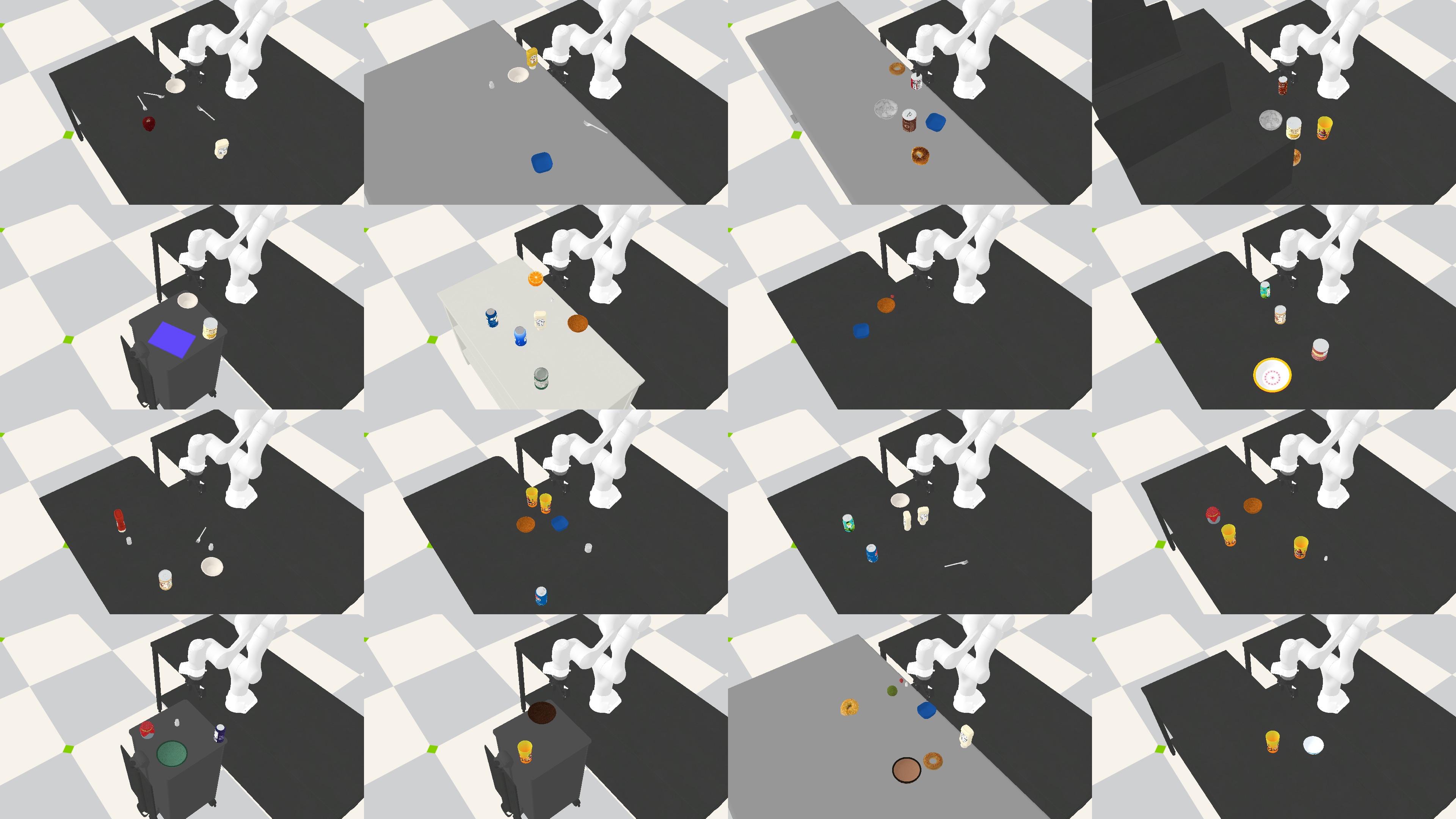 ## Type of change - New feature - Documentation update ## Checklist - [x] Read the contribution guidelines - [x] Run formatting and lint checks - [x] Update documentation - [x] Validate behavior with focused coverage and apply the test-audit criteria - [x] Add package changelog fragments - [x] Contributor names already exist in `CONTRIBUTORS.md` --------- Co-authored-by: Octi Zhang <zhengyuz@nvidia.com>
 ooctipus
changed the title
ooctipus
added
the
ci:run-docker

|
run-ci |
 isaaclab-bot
Bot
added
ci:run-docker



Description
Evaluate pi0.5 on
IsaacContrib-TableTop-PickPlace-Frankafrom merged #9165 with one command. The first run fetches a pinned OpenPI revision, prepares its separate Python 3.11 environment, anonymously downloads the joint-position checkpoint and starts inference. Subsequent runs reuse the caches. Evaluation shuts down its inference process on completion or interruption.The PR adds two scripts: the evaluator owns scene setup, trial scheduling and local process lifetime; the server entrypoint owns OpenPI model configuration and loading. There are no framework, task, asset or dependency-file changes. OpenPI's dependencies stay outside the Isaac Lab environment.
Any idle world requests the next global task-family ID and resets to a fresh object count, category composition, assets and table. Each episode records its instruction, objects, mesh variants, table variant and success/timeout. Completed worlds discard their remaining action chunk and hold their reset arm pose with the gripper open. Every terminal result counts, including one-step episodes.
The client uses the standard OpenPI WebSocket protocol, querying active worlds serially. No custom batch adapter is required. Camera updates follow the action chunk interval; both views are letterboxed to 224 × 224, and DROID gripper closure maps to the environment's binary command.
Run
With Isaac Lab installed on Linux and an NVIDIA GPU, git and uv available:
No manual OpenPI installation, server launch or Google login is required. The first run downloads the approximately 12.4 GB
gs://openpi-assets-simeval/pi05_droid_jointposcheckpoint. Source/environment are cached under~/.cache/isaaclab/pi05; weights/tokenizer use~/.cache/openpi(OPENPI_DATA_HOMEoverrides it). Inference uses the first visible GPU without JAX preallocation; simulation and inference must fit in available GPU memory.Optional controls:
--num_envs 4 --trials 2: two trials per task family, distributed across four worlds.--policy-device 1: select another inference GPU throughCUDA_VISIBLE_DEVICES.--checkpoint /path/to/pi05_droid_jointpos: reuse existing weights.--policy HOST:PORT: use an existing standard OpenPI joint-position server and skip local setup.--tasks put_in_container: select a task family.env.episode_length_s=10: ordinary task configuration overrides.Reports go to a new timestamped directory under
logs/pi05;--output PATHselects one explicitly. The action contract is seven absolute arm joint positions and gripper closure in [0, 1]. The standard velocity-action DROID checkpoint is incompatible.Validation
215abfb217dbac7d5f1273282331b9b1866c0479and locked dependency installation succeeded.Release backport
mainType of change
Checklist