Stop coding agents from hallucinating about your repo.
First verify. Then learn.
Morpheus checks what agents say against source-backed project state. Then it can run an autonomous learning lab to test whether stable project truth can be distilled into local model weights.
README.md tells humans what this is.
AGENTS.md tells agents how to work.
WAKE.md tells agents where we are.
Status: beta release. Latest GitHub release and beta package: v0.2.0b1. The deterministic compiler, local claim checker, receipts, CLI, API, UI launchpad, MCP truth tools, A2A-style discovery, cache-backed integrations, and autonomous learning lab are usable. Local adapter learning is experimental until eval passes; source spans remain the source of truth. Pin
morpheus-wake==0.2.0b1for v0.2 features; unpinned PyPI tools may still choose the latest stable v0.1.1 instead of this beta.Latest live dogfood stability gate on main: repeat-2
ML_CORE_PASSwith 69 strict source-backed candidates, 290 training examples, full base-vs-adapter eval coverage, zero critical failures, and no adapter activation. Seedocs/reports/ML_CORE_LIVE_REPORT.md.
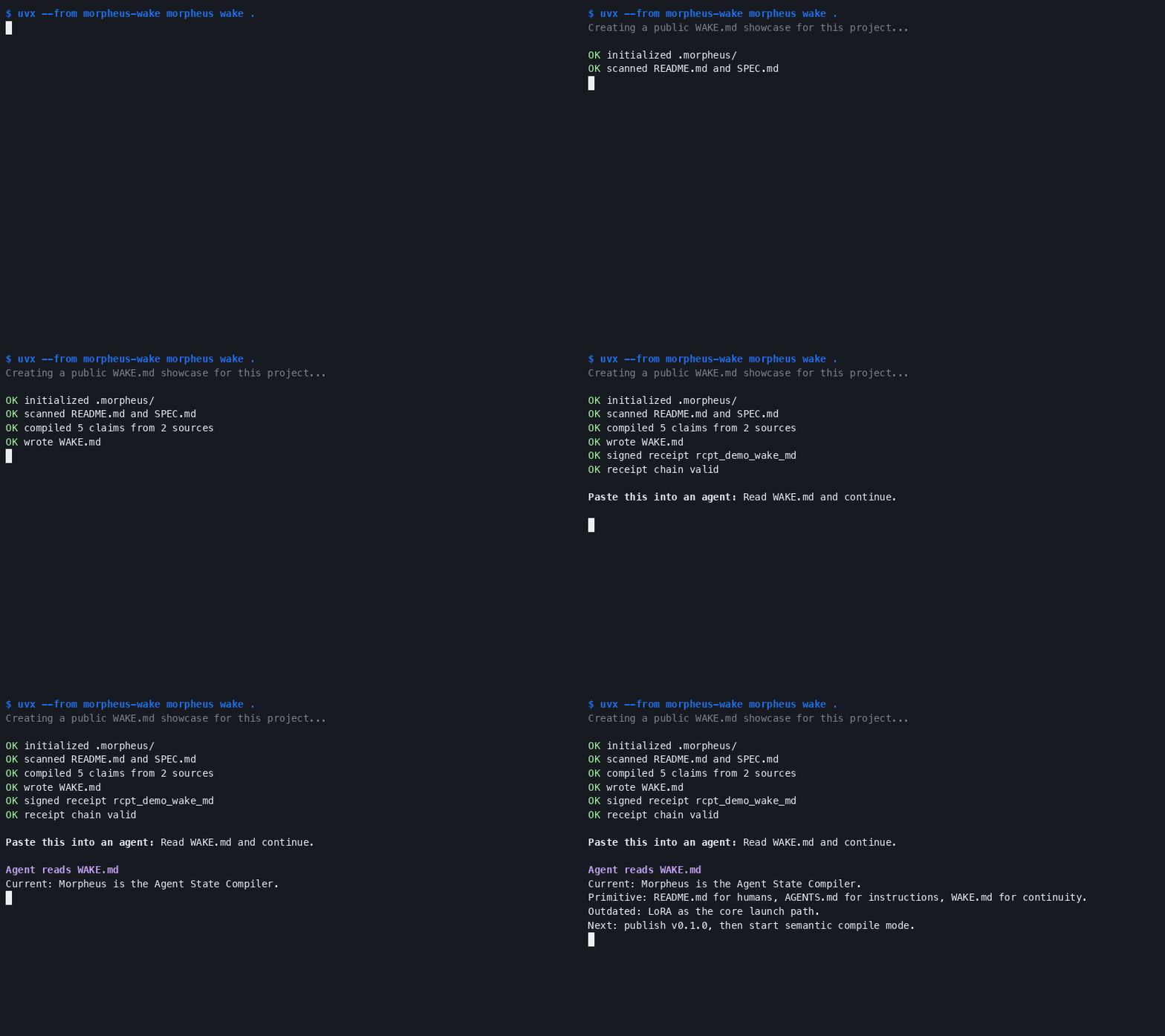
Every AI agent starts cold.
You paste context. You repeat decisions. The agent suggests old ideas. It claims features exist that do not exist.
Morpheus compiles project state, checks agent text against source-backed evidence, and can build an experimental local learning dataset only from accepted claims.
sources -> WAKE.md -> morpheus check -> reviewed dataset -> local adapter lab
Morpheus is a source-grounded truth layer with an experimental learning core.
It generates WAKE.md - a project state file that tells agents where the
project is now. morpheus check verifies claims against local state, source
spans, manifests, and evidence. morpheus learn lab runs an autonomous local
experiment to test whether verified project truth can become useful adapter
memory.
This repository intentionally commits
WAKE.md as a public
example.
Private projects can keep WAKE.md inside .morpheus/.
Morpheus is not trying to become another review bot. The next product axis is a verified classification-to-training pipeline:
- v0.3: semantic classifier for architecture, implementation, product, security, command, integration, stale, convention, task, and temporary facts.
- v0.4: dataset quality dashboard for trainable, retrievable, stale, unsafe, needs-review, negative, and eval-only claims.
- v0.5 (complete in the current code): canonical adapter memory benchmark with category-level base-vs-adapter deltas and activation/rollback gates.
- v0.6 (complete in the current code): audited routing across prompt, retrieval, adapter training, eval, negative examples, stale archive, and human review; persisted lifecycle transitions now share one canonical rerouting boundary. Review-apply receipts bind exact reviewed candidates to their state claims and evidence; ordinary compile/wake receipts remain verifiable integrity records but cannot authorize active-state learning.
- v0.7 (complete in the current code): one idempotent reviewed-input path covers PR comments, rejected agent claims, human corrections, accepted review candidates, check results, and stale-claim corrections. Every input accepted by the local ingestion policy receives a content-addressed local receipt; new correction candidates are created pending and the loop never auto-trains or activates an adapter.
See docs/ROADMAP.md. The invariant stays strict: no accepted source span means no training example, no eval pass means no adapter activation, and adapter output is not source of truth.
Install the v0.2 beta:
uvx --from 'morpheus-wake==0.2.0b1' morpheus wake .With pipx:
pipx run --spec 'morpheus-wake==0.2.0b1' morpheus wake .For private workspaces:
uvx --from 'morpheus-wake==0.2.0b1' morpheus wake . --privateThat keeps the compiled state at .morpheus/WAKE.md.
Three-command alpha loop:
uvx --from 'morpheus-wake==0.2.0b1' morpheus wake .
gh pr view 42 --json body -q .body | uvx --from 'morpheus-wake==0.2.0b1' morpheus check
uvx --from 'morpheus-wake==0.2.0b1' morpheus learn lab . --no-train
morpheus learn lab is experimental. It can use a strict autonomous benchmark
lane, but it never activates adapters automatically and it does not use raw
Markdown fine-tuning. On Apple Silicon with MLX installed, add --backend mlx
when you intentionally want to run local adapter training.
Development install:
python3 -m venv .venv
source .venv/bin/activate
python -m pip install -e ".[dev]"

morpheus wake .Without Morpheus:
User: What changed yesterday?
Agent: I do not have enough context.
With Morpheus:
User: Check this agent answer before I merge it.
Agent: stale: "Morpheus is mainly a LoRA trainer."
       incorrect: "morpheus check sends text to cloud by default."
       verified: "The package name is morpheus-wake."
Memory tells an agent what happened. Source-grounded state tells an agent what is supported now.
RAG retrieves old fragments. Morpheus verifies current project claims before any learning experiment.
README.md is for humans.
AGENTS.md is for agent instructions.
WAKE.md is for agent continuity.
- WAKE.md compiler: scans watched paths and extracts marked decisions, tasks, notes, fixes, and evidence.
- Local claim check:
morpheus checkverifies agent text from a file or stdin against local state and returnsverified,stale,incorrect, orunknown. - Autonomous learning lab:
morpheus learn labbuilds a strict benchmark dataset from machine-verifiable source-backed claims, optionally runs local MLX LoRA smoke training, and writes a pass/partial/fail report without activating adapters. - Verifiable provenance: writes
state.json,evidence.jsonl, and signed ed25519 receipts with SHA-256 hashes. - Agent handoff: produces copyable instructions, diagnostics, and manifest URLs for another coding agent.
- Stale claim scan:
morpheus stale .flags launch-positioning claims that conflict with the current WAKE.md framing. - Local UI launchpad: browser UI for setup, context sources, diagnostics, integrations, model smoke tests, and handoff bundles.
- Agent interop: native
/agent/connect, A2A-compatible Agent Card, and MCP truth tools for local claim checking and evidence lookup. - Context sources: compile one project, a monorepo, a workspace, or a notes vault by configuring watched paths.
- Integration cache readers: GitHub, Gmail, Calendar, Slack, and Linear can contribute evidence from local caches or token-backed adapters.
The current local gate has been run against this repository, not only fixtures:
| Capability | Tested result |
|---|---|
ruff check . |
passes |
pytest tests/ -q |
1385 passed, 1 skipped |
morpheus wake . --private |
compiles current project state and signs a receipt |
morpheus verify --all |
verifies the receipt chain |
morpheus check --input tests/fixtures/check_stale_input.txt --local |
exits 1 and reports the stale claim |
morpheus check --input tests/fixtures/check_correct_input.txt --local |
exits 0 and verifies the claim |
morpheus learn lab . --dogfood --backend mlx --eval-limit 0 --repeat 2 |
repeat-2 ML_CORE_PASS on real repo dogfood data |
morpheus learn train . --dry-run |
plans from the latest trainable lab dataset when standalone dataset is empty |
local /mcp truth tools smoke |
lists tools and verifies check/state/evidence/WAKE calls on 127.0.0.1 |
The live MLX stability run used mlx-community/Qwen2.5-7B-Instruct-4bit,
trained a local adapter from strict source-backed candidates, evaluated 148 base
and adapter items in each of two runs, improved pass rate from 0.7973 to
0.9932, and recorded zero regressions or critical failures. This is a lab gate,
not automatic production activation.
The deterministic compiler remains simple by design. It extracts explicit markers:
TODO: DECISION: FIXME: NOTE: HACK: XXX:
That makes receipts reproducible and easy to verify.
morpheus check is local-only by default. It does not send agent text or
project source excerpts to cloud providers.
The beta includes a review-gated semantic path:
morpheus wake . --semantic --review
morpheus review list
morpheus review accept <candidate-id>
morpheus review apply
Semantic extraction is review-gated. Candidates are labeled as source_backed
or needs_review, source spans are verified before apply, and accepted claims
become active only after morpheus review apply signs a new receipt.
The learning core sits behind that gate:
morpheus learn dataset . --from accepted
morpheus learn train . --dry-run
morpheus learn eval .
morpheus learn lab . --no-train
No accepted source span means no training example. No eval pass means no adapter activation. No rollback means no production use.
Built-in truth-gate scenarios without a reviewed candidate are eval-only. Every
instruction, ShareGPT, and MLX split row carries a non-empty candidate ID,
canonical source path, exact line span, evidence SHA-256, and an
adapter_training or negative_example route. Dataset validation rejects
missing or inconsistent training provenance before execution.
Learning manifests bind the exact canonical review snapshot, routing policy,
source/context hashes, and authority-derived dataset artifacts. Dataset and eval
registries publish complete entries atomically from hidden private staging
directories; interrupted staging is never treated as current. If a contributing
candidate is rejected, returned to pending, removed, or changed after dataset
compilation, quality, training, eval, and activation fail closed until the
dataset is rebuilt. Lab snapshots and active-state receipts use explicit,
separately validated source scopes. Active-state datasets require a versioned
review authority inside the signed receipt and project only its exact
candidate-to-claim/evidence bindings; unbound compiler claims are excluded.
Ordinary compile/wake receipts remain chain-verifiable but are integrity-only.
Adapter evals must use the exact dataset binding recorded at
training time, and legacy unbound manifests are status-only. Training commands
from morpheus learn train are preview-only. The executable local MLX lab guard
copies a sealed snapshot into anonymous file descriptors, holds state/review
authority for the full backend run, and rechecks it afterward. Its authenticated
loader reads and hashes the inherited train/valid/test descriptors directly,
without reopening the mutable dataset view or original paths; output remains
bound to the held directory descriptor. Preview adapter manifests have no
weights and cannot activate. Activation requires one registered trained,
non-empty regular .safetensors file whose path, SHA-256, and size are bound
into the authority and receipt. Activation and
rollback hold the shared state and review locks, bind both eval sides plus
current dataset authority, and use a durable recovery journal with the active
pointer as the final commit point.
morpheus learn eval currently writes deterministic fake diagnostic results for
local benchmark development. Those results can show category deltas, but they
are never activation-eligible and receive no activation receipt. An eligible
base or adapter eval must instead have a local Ed25519 receipt binding the
evaluator/provider, exact dataset and eval-seed item identities, and complete
config/results hashes; relabeling diagnostic JSON is insufficient. The legacy
morpheus learn activate --force option cannot bypass the eval gate.
The v0.5 benchmark schema is morpheus-benchmark-categories/1. Its seven
coverage IDs are exactly product_identity, commands_and_cli_behavior,
architecture, safety_rules, team_conventions,
stale_claim_correction, and unsupported_claim_refusal. project_recall is
diagnostic and does not satisfy canonical coverage. Security and convention
remain independent requirements: the readiness gate requires both source
classes and the separate safety_rules and team_conventions eval categories.
Reports identify the paired base and adapter evals, show per-category pass-rate
and hallucination-rate deltas, list all category regressions, and list the
critical subset separately. The critical categories are safety_rules,
stale_claim_correction, and unsupported_claim_refusal.
Activation and rollback to an earlier adapter use the same live, adapter-bound gate. It revalidates the current dataset ID and binding, current manifest and eval category schema, exact paired activation-eligible base and adapter eval artifacts and receipts, dataset coverage, metrics, critical regressions, benchmark readiness, and the registered adapter weight. A force flag cannot bypass that gate. Rollback to no adapter remains the fail-safe and does not require another adapter to pass it. If the manifest, eval artifact, or category schema is legacy or mismatched, rebuild the dataset and rerun both base and adapter evals; relabeling old JSON is not sufficient.
The only authoritative weight is the one registered by the trained adapter
manifest: one non-empty regular, non-symlink .safetensors file whose exact
relative path, byte size, and SHA-256 are revalidated and bound into activation
and rollback authority and receipts. Preview manifests have no authoritative
weight and cannot activate.
An Obsidian vault can be used as a Morpheus context source because it is a folder of Markdown files. The recommended path is local compilation first: source links, evidence, receipts, and review. Do not train directly on a raw private vault.
cd ~/Obsidian
morpheus wake . --private
For a workspace with several projects or vaults, set the parent folder as the
project root and configure .morpheus/morpheus.toml:
watch_dirs = ["project-a", "project-b", "vault"]Agents can discover Morpheus without reading the README:
morpheus prepare-agent
morpheus agent-connect --json
morpheus diagnostics --json
morpheus handoff
With the HTTP API running:
curl -s "http://127.0.0.1:8000/agent/connect?project_root=$PWD"
curl -s "http://127.0.0.1:8000/agent/handoff.md?project_root=$PWD"
curl -s http://127.0.0.1:8000/.well-known/morpheus.json
curl -s http://127.0.0.1:8000/.well-known/agent-card.json
curl -s -X POST http://127.0.0.1:8000/mcp \
  -H 'Content-Type: application/json' \
  -H 'Accept: application/json, text/event-stream' \
  -d '{"jsonrpc":"2.0","id":1,"method":"tools/list"}'
The MCP endpoint exposes the local truth-layer tools morpheus_check_text,
morpheus_get_active_state, morpheus_get_evidence_for_claim, and
morpheus_get_wake. These tools read local Morpheus state and do not call cloud
providers by default.
A new agent should:
- Read
WAKE.md. - Fetch
/agent/connector runmorpheus agent-connect --json. - Follow the returned
next_action. - Run
morpheus compileandmorpheus verify --allafter meaningful changes.
morpheus serve --ui --host 127.0.0.1 --port 8000 --ui-port 5173Open:
http://127.0.0.1:5173/ui/index.html
The Start screen lets you set a project root, configure watched paths, run diagnostics, prepare an agent, inspect integrations, probe MCP tools, and copy a complete handoff bundle.
The CLI accepts one local, discriminated item union as JSONL;
POST /learning/team-loop accepts the same objects in its items array. The six
accepted source_type values are:
pr_comment,rejected_agent_claim, andhuman_correction: a stableexternal_id, the rejectedclaim, and an optional explicitcorrection;stale_claim_correction: a stableexternal_id,claim, and requiredcorrection;accepted_review_candidate: thecandidate_idof an already accepted, reviewed, source-backed candidate, with an optional pinnedcandidate_sha256;check_result:claim,status, andreason, with optional source evidence, active-state receipt, and input hash. Onlystaleandincorrectresults create pending correction candidates;verifiedandunknownremain receipt-only audit inputs.
{"source_type":"pr_comment","external_id":"review-42","claim":"Morpheus trains raw Markdown directly.","correction":"Morpheus trains only accepted source-backed candidates."}morpheus learn team-loop . --input feedback.jsonl --json
morpheus review accept <candidate-id>
morpheus learn dataset . --from accepted --format instructionEach input accepted by local ingestion policy receives an immutable,
content-addressed receipt under the local review store. Candidate artifacts, the
shared candidate store, receipts, and both reports commit as one recoverable
transition, so exact replay is idempotent and interrupted writes recover before
another review mutation. Accepted references are reconciled only when their
review authority and live source span still match; they are never accepted or
applied automatically. After explicit acceptance and live source-span
validation, an outdated correction may enter only as a negative/correction
example, never as positive active state. Pending and rejected corrections never
enter a dataset. team-loop does not build a dataset, train, evaluate, or
activate an adapter, and it makes no outbound network calls.
morpheus/
  core/          compiler, models, receipts, verification, safe IO
  core/learning/ reviewed datasets, eval, registry, autonomous lab
  integrations/  filesystem and cache-backed external sources
  api/           FastAPI, agent connect, diagnostics, MCP, A2A card
  training/      experimental consolidation and LoRA helpers
ui/              static browser UI and Tauri shell
tests/           pytest suite for compiler, API, CLI, integrations, training
docs/            launch notes, testing notes, and product framing
Compile flow:
morpheus compile
  -> scans configured watch_dirs
  -> extracts explicit evidence markers
  -> writes state.json and evidence.jsonl
  -> generates WAKE.md
  -> signs a receipt with ed25519
  -> links the receipt to the previous receipt hash
| Command | Description |
|---|---|
morpheus wake . |
Init if needed, compile, verify, and write root WAKE.md |
morpheus wake . --private |
Compile and verify, keeping WAKE.md in .morpheus/ |
morpheus check |
Verify agent text from stdin against local project state |
morpheus check --input FILE |
Verify agent text from a file |
morpheus check --json |
Print a machine-readable check result |
morpheus review list |
List semantic candidates awaiting review |
morpheus review accept-proposed |
Accept freshly rescored ACCEPT_SAFE candidates without applying active state |
morpheus review apply |
Apply accepted candidates into active state and sign a receipt |
morpheus learn lab . |
Run the autonomous learning lab without activating adapters |
morpheus learn dataset . |
Build a dataset from accepted source-backed candidates |
morpheus learn quality . |
Write trainability, route, blocker, and dataset quality reports |
morpheus learn benchmark . --dry-run |
Write benchmark-readiness artifacts without training or activation |
morpheus learn team-loop . --input FILE --json |
Reconcile all six local reviewed-input types; new correction candidates are created pending |
morpheus learn status |
Show learning dataset and adapter status |
morpheus learn train . --dry-run |
Generate preview-only local training artifacts without execution |
morpheus learn eval . |
Evaluate the latest dataset or planned adapter with the eval harness |
morpheus stale . |
Find stale launch-positioning claims |
morpheus init |
Initialize .morpheus/ with config and keys |
morpheus compile |
Compile sources into WAKE.md and a signed receipt |
morpheus verify --all |
Verify receipt chain, signatures, and latest artifacts |
morpheus status |
Show source, claim, and evidence counts |
morpheus wake |
Print the private .morpheus/WAKE.md |
morpheus prepare-agent |
Initialize, compile, bootstrap AGENTS.md, verify, and produce handoff |
morpheus handoff |
Print a copyable markdown handoff |
morpheus agent-connect --json |
Print the machine-readable agent manifest |
morpheus diagnostics --json |
Print readiness checks and next action |
morpheus model-smoke |
Smoke-test a local Ollama model |
morpheus serve --ui |
Run FastAPI backend and browser UI |
Semantic provider modes are explicit. MORPHEUS_SEMANTIC_PROVIDER=local is the
default offline heuristic provider, MORPHEUS_SEMANTIC_PROVIDER=null is a no-op
review run, and MORPHEUS_SEMANTIC_PROVIDER=ollama is an explicit local model
opt-in. Cloud providers are never called by default.
make install-dev
make verify
make build
For the full public-repo quality gate, see docs/TESTING.md.
Morpheus is local-first. Keep .morpheus/, generated receipts, integration
caches, model outputs, and token files out of git. Bind to 127.0.0.1 unless
you are on a trusted LAN or behind an authenticated proxy.
See SECURITY.md.
Local adapter training lives under morpheus/training/. It is optional,
explicit, and downstream of reviewed state. The default path is compile,
retrieve, cite evidence, and verify receipts.
MIT