A small 1C:EDT plugin that hands EDT's live semantic model to AI agents and other tools over the Model Context Protocol (MCP).
A static parser reads source files. EDT-Bridge asks the running IDE instead, so it can answer what only the live model knows: EDT's own validation problems, the real structure and types of the metadata, semantic cross-references, query validation against the project's actual metadata, and the platform Syntax Helper that ships with EDT. Reading is half of it. The write tools create, refactor, build and deliver; infobases and a debugger come with them. All of it runs on EDT's own engine.
Read and write. Localhost only. A write needs the token and returns a plan until you ask for more. The plugin lives inside EDT, so an EDT – GUI or headless – has to be up with your project.
English · Русский
Documentation: docs.keyfire.ru/edt-bridge
Development notes and updates (in Russian): the 1C × AI: engineering workshop Telegram channel.
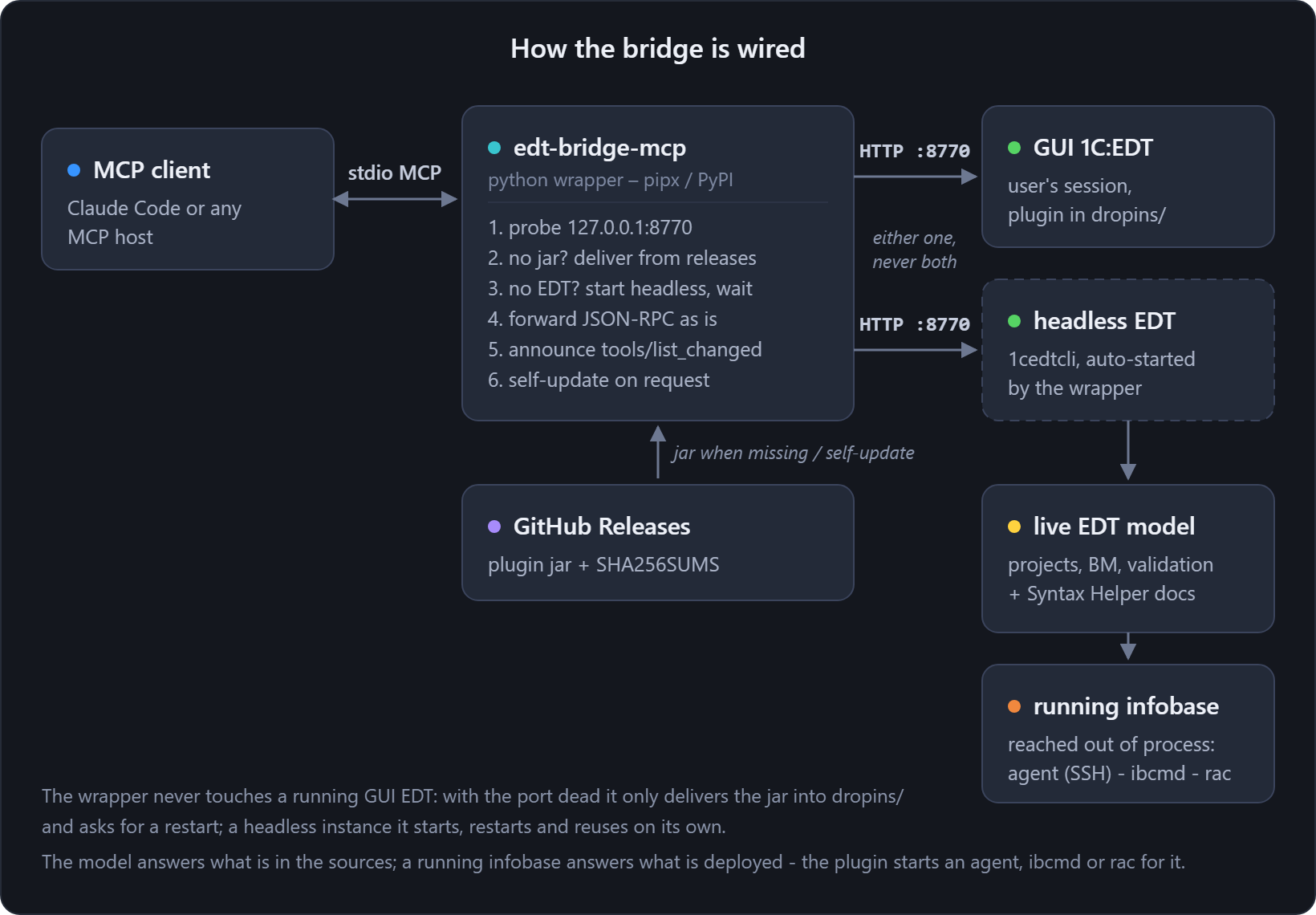
One command sets up both halves, the client wrapper and the plugin. The
edt-bridge-mcp wrapper is a stdio MCP server that your client talks to. It
forwards to a running EDT, starts a headless EDT when none is open, and delivers the plugin
jar into EDT's dropins/ when it is missing. You never copy a jar by hand.
pipx install edt-bridge-mcpThen register it with your MCP client. Claude Code is shown here; --workspace is the EDT workspace
to serve when the wrapper starts a headless EDT:
claude mcp add edt-bridge -- edt-bridge-mcp --workspace "D:\\path\\to\\edt-workspace"That is the whole setup. Wrapper flags, the write-tools token and self-update are documented in
python/README.md. To run the plugin yourself, without the wrapper, see
Manual install below.
Don't have pipx?
pipx installs Python CLI apps into isolated environments. Install it once:
python -m pip install --user pipx
python -m pipx ensurepath      # then reopen the terminal
macOS: brew install pipx && pipx ensurepath. More: https://pipx.pypa.io.
The plugin has a preference page of its own, Window ▸ Preferences ▸ EDT-Bridge. That is where the token comes from when the bridge runs inside a GUI EDT:
| Setting | What it is |
|---|---|
| Token for write tools | The shared secret every write tool requires. An empty token means writes are refused, not that they are open to anyone. The client gets the same value as EDT_BRIDGE_TOKEN. |
| MCP server port | 8770 by default. It takes effect after EDT restarts, so the running server keeps the old port until then. |
| Allow arbitrary BSL evaluation while debugging | Off by default. It guards edt_evaluate, which executes code against a live infobase. Test stands only. |
A launch parameter wins over this page. -Dedt.bridge.* system properties and EDT_BRIDGE_*
environment variables given at startup take precedence over the stored values. That is how the
wrapper drives a headless EDT, and it is also why a token set here can look ignored when one was
passed on the command line as well.
Tool names are edt_* in snake_case, parameters are camelCase: projectName, fqn, queryText.
Object names are Cyrillic, as in the configuration; the type prefix is English:
Catalog.Контрагенты, Document.ЗаказКлиента. An MCP host shows the agent one flat list of every
server's tools, so each name has to carry its own context. Hence the edt_ prefix: edt_rename
says what it renames, where a bare rename does not.
A parameter the tool does not declare refuses the whole call. The refusal names the near miss
(deleteContents → deleteContent) and lists what the tool does take. Skipping an unknown
parameter in silence would report success for a call that did something else.
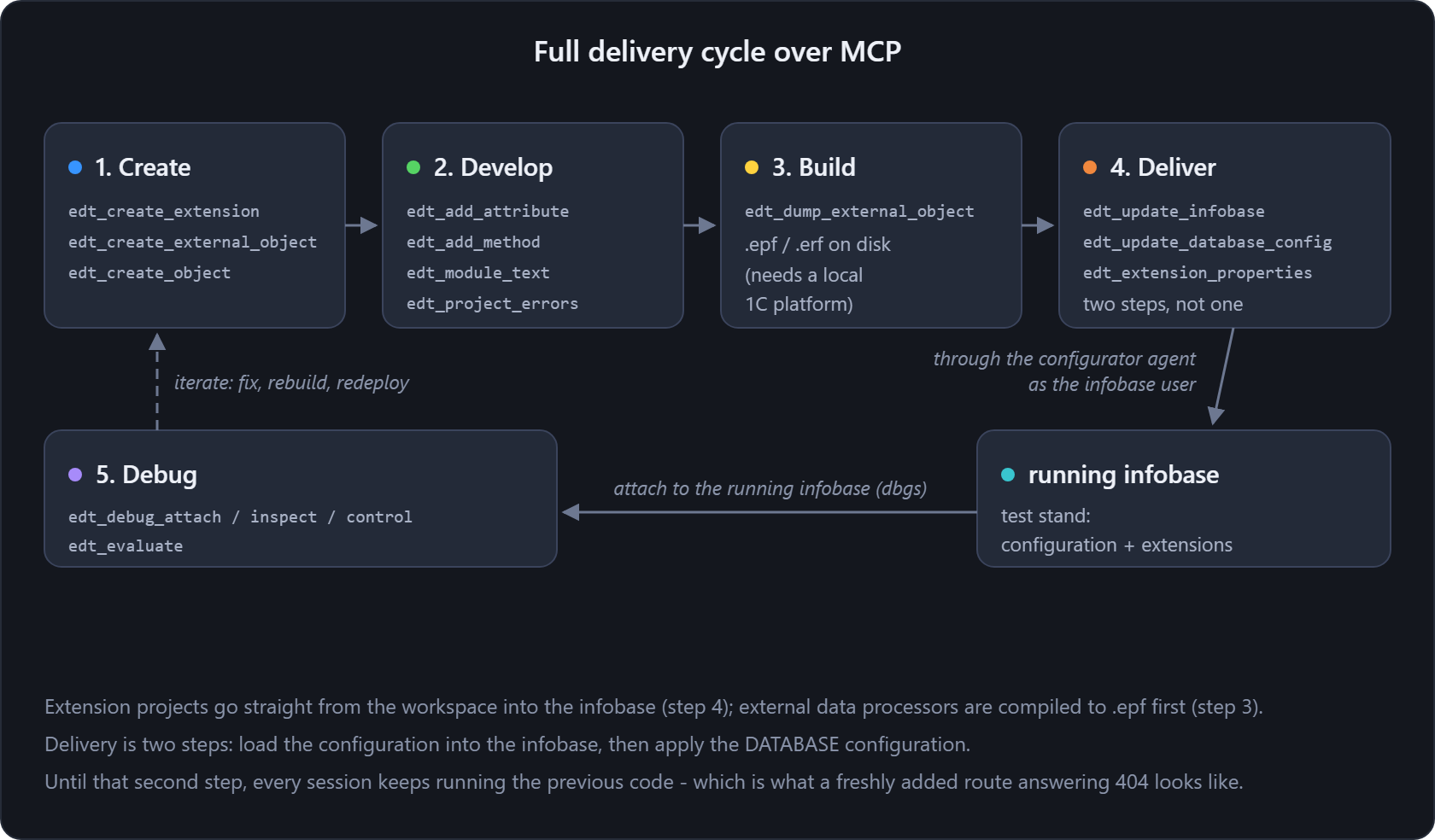
Together the tools close the whole cycle without leaving MCP: create, develop, build, deliver, debug.
| Tool | What it returns |
|---|---|
edt_projects · edt_project_errors |
The open workspace projects: name, disk location, natures, and whether each one is a 1C:EDT project. Then a project's EDT validation problems with message, severity, resource and line. Narrow them by fqn, modulePath or severity, count them with countOnly, or get one text line per problem with brief. Start here to find out what you can address at all. What comes back is EDT's own grading, and EDT grades a call to a method another module does not have as a WARNING (SU239, "Property (method) of object is not defined"). Only an undefined bare call is an error, so a check of generated code has to read the warnings too. modulePath reaches the Eclipse markers alone. An EDT check marker is addressed by object, so narrow by fqn to see both kinds. An fqn that names a form (...Form.<Name>) is matched by the form's name as well, otherwise the object's other forms would answer too. A marker is a snapshot, so every problem is judged against its file: stale means the marker predates the file's last change on disk, unsynchronized means the workspace has not read that change yet. The summary counts both (staleCount, unsynchronized) and a hint says what to do about them. refresh=true re-reads the narrowed scope from disk and runs an incremental build before the markers are read. That takes seconds for one module, where edt_clean_project rebuilds everything. |
edt_check_info |
What a validation check actually means: its description, the non-compliant and compliant examples, and the links to the 1C development standards behind it, in English or Russian. It goes with edt_project_errors, which names the check that fired. That one answers what, this one answers why. Ask by check id, or paste the problem message. A check whose id is a short code is found by its title. |
edt_metadata_objects · edt_metadata_details |
Top-level metadata objects, optionally filtered by type (Catalog, Document, ...) and by a name substring. Then one object's core properties and its structure: attributes, tabular sections, forms, commands, templates, dimensions, resources, enum values, each attribute with its value type. |
edt_find_references · edt_outgoing_calls · edt_outgoing_structures |
Which way the calls go. Inbound references to a metadata object come from EDT's cross-reference index; with method you get the BSL call sites of CommonModule.X.method. The reverse direction lists the methods a module, a method or a form calls one level out, with call-site counts and a flag for the ExtAPI layer. The third tool reads, as far as it can, the top-level keys of the Структура passed to each qualified outgoing call. |
edt_module_text · edt_go_to_definition · edt_symbol_info |
Reading BSL. A module's source, or one method of it, with the list of procedures and functions and their signatures, addressed by FQN or by modulePath. A symbol's definition at a position: kind, name, owning object, location. And the type at a position: the element under the cursor and the computed value types of the expression. |
edt_search_modules |
Full-text search across a project's BSL modules, by substring or regular expression, with an optional path filter. It reads through Eclipse's file buffers, so a module open in an editor is searched as it stands right now, unsaved edits included. edt_find_references answers "who calls this method"; this one answers "where does this text appear". |
edt_validate_query |
Checks a 1C query against the project's live metadata: syntax and semantics, so unknown tables and fields and type errors come back with positions. Takes the query text, or a module address (modulePath, optionally one method). Given a module, the bridge pulls the |-framed query literals out of the live module itself and checks each one. The batch is followed as a whole too, which EDT does not do. A query that reads a temporary table no earlier query puts there (ПОМЕСТИТЬ), or one an earlier query has dropped, makes the text invalid. For a module literal that is an INFO note instead, because the table may come from a shared temporary table manager or from another literal. |
edt_form_structure · edt_form_render · edt_picture_export |
Forms and images. The items tree of a managed form – fields, groups, tables, buttons, decorations – with data bindings, static visible/enabled/readOnly, per-item event handlers, input-field properties, the button-to-command wiring and the form's conditional appearance, plus its attributes, commands, parameters and handlers. The same form rendered to a PNG by EDT's own offscreen renderer, with a choice of interface variant and theme. And the content of a CommonPicture out of its Picture.zip. |
edt_platform_help |
The 1C:Enterprise platform Syntax Helper that ships with EDT: the real API reference of objects, methods, properties and events, in Russian and English. Search by name, or read a page as text. Look the API up instead of guessing a signature. |
Write tools change the model through EDT's own engine, not by editing text. Every one of them needs
the token, and every one does nothing until asked: apply=false is the default and returns a plan.
apply=true makes the change and serializes the .mdo.
| Write tool | What it does |
|---|---|
edt_create_object · edt_delete_object |
Creates a new top-level object – Catalog, Document, Enum, InformationRegister and the rest – through EDT's factory and the per-type initializer, and registers it in the Configuration. Deletion cascades: every reference in metadata and in BSL goes with the object, which is why it needs force. |
edt_add_attribute · edt_modify_attribute · edt_remove_attribute |
Adds an attribute to a metadata object with a validated type, klass, synonym and comment; changes an existing attribute's type, synonym or comment; removes one. Removal checks the references first and refuses while any remain, unless forced. |
edt_rename |
Renames an object or a member and carries every reference in metadata and in BSL along with it, through EDT's native refactoring engine. Needs force, because a rename breaks whatever was built on the old name. |
edt_add_method · edt_delete_method |
Adds and deletes a procedure or function in a module's BSL, both guided by the model. The insert refuses any result that would not parse again. The cut takes the adjacent doc comment with it, and its plan returns the exact text that will go, which is why it needs force. Both address a module by FQN, HTTPService.X and WebService.X included. |
edt_add_route |
Adds a route to an HTTPService: a URL template plus one HTTP method. It generates the uuid of the template and of its method, and writing those by hand is exactly what the bridge exists to spare you. It resolves the httpMethod enum, and with createHandler it splices a Функция <handler>(Запрос) stub into the service module. |
edt_add_form |
Adds a managed form to a metadata object through EDT's own form generator, the engine behind the "New form" wizard. The form, its items and its module are generated rather than written out as XML by hand. |
edt_add_form_attribute · edt_modify_form_attribute · edt_remove_form_attribute |
Adds, changes and removes a form attribute, or a column of a value-table attribute when you pass columnOf. Ids come from EDT's form identifier service. Besides the metadata type grammar these take the platform types a form may hold (ТаблицаЗначений, СписокЗначений and so on) and the object types ВнешняяОбработкаОбъект.X and СправочникОбъект.X, the kind a main attribute carries. Removal lists the items bound to the attribute and needs force. |
edt_add_form_command · edt_modify_form_command · edt_remove_form_command |
Adds, changes and removes a form command. Adding can write the handler procedure's stub into the form module as well, creating that module when the form has none. Removal lists the buttons wired to the command and needs force. |
edt_add_form_handler |
Registers an event handler on a form or on one of its items. This is the handlers entry in Form.form, and without it the platform never calls the procedure while validation says nothing. The allowed events come from EDT itself, so a misspelled one is refused with the list attached. It can also write the stub, with the signature the event declares and the directive its environments imply. |
edt_add_form_item · edt_modify_form_item · edt_remove_form_item |
Adds, changes and removes a form's visual items: field, table, button, group, decoration. It goes through EDT's own IFormItemManagementService, the service the form editor calls. A table bound to a value-table attribute gets its columns filled in automatically. A titleRu given to the table stays on the table, and the generated columns keep EDT's own default. Changing an item also renames it with newName: an item's name lives in the form model, and the handler procedures keep theirs. Removal takes everything nested inside and needs force. |
edt_adopt_object |
Adopts an object of the base configuration into an extension project through EDT's own IModelObjectAdopter. Nothing in an extension can intercept that object until this happens, and it is the step that completes edt_create_extension. |
edt_import_project |
Registers a project directory that already exists in the workspace: "Import existing project" without the dialog. The create-work-delete cycle lacked this step. An extension in modification-and-control mode is validated against a base project on the target release, and that project comes from another worktree. Nothing on disk is rewritten, and a name of its own lets two working copies of one repository live side by side. |
edt_create_extension · edt_create_external_object |
Starts a project. Either a configuration extension against a base project through IExtensionProjectManager, whose root Configuration is the base configuration adopted the way the wizard does it, which is what makes the project loadable into an infobase, plus a name prefix, a purpose (Customization, AddOn or Patch) and a synonym. Or an external data processor project, where the "processor → .epf" cycle begins. |
edt_clean_project · edt_delete_project |
Finishes with a project. Either discard its build results so that validation runs again: EDT's "Clean" dialog driven programmatically, reporting the problem count before and after and waiting until that count settles, because a stale marker outliving its cause is worse than no marker at all. For one module changed on disk, edt_project_errors with refresh=true is the light alternative. Or remove the project from the workspace through the Eclipse workspace, so that no ghost project is left behind. Removal needs force, since it cannot be undone. |
edt_build_extension · edt_dump_external_object |
Builds the binaries: a .cfe from an extension project, an .epf or .erf from an external data processor or report. Both can go around EDT's platform resolver when it serves no thick client. They export designer XML in-process, then assemble the file with a full on-disk 1C install in a temporary infobase that is deleted afterwards. logPath keeps the platform's build log next to the artefact. The dump falls back to the on-disk route when EDT's own dumper refuses, route pins it to edt or disk, and the auto-dump generation is put back if the refusal switched it off. |
These tools talk to a running infobase rather than to the model in EDT. There are four ways in, and they are not interchangeable. The Through column says which one a tool uses.
- EDT's own synchronization is what the IDE itself uses. It opens its own infobase connection and has no way to take credentials from outside the UI, so it stops at an infobase that authenticates its users.
ibcmdgoes straight at the database, by file path or by DBMS coordinates, so a clustered infobase needs no cluster access. Itsextensionmode has no 1C credentials at all.- the configurator agent is a designer started with
/AgentMode. It takes commands over SSH and authenticates as the infobase user, which is how it reaches what the other two cannot. The bridge keeps one agent per infobase: starting one is slow, holding one is cheap. racis the cluster itself, and that is where sessions live. Neither the agent noribcmdsees them.
Tools that change an infobase need the token and return a plan by default, exactly like the write tools above.
| Tool | Through | What it does |
|---|---|---|
edt_infobases · edt_platform_installations |
EDT | What the platform side has to work with. EDT's registered infobases with name, uuid and connection string, and the associations the open projects have with them. Then the 1C:Enterprise installations EDT resolves from when it dumps an .epf or .erf or creates an infobase, each one resolved to a concrete install that carries a thick client, plus the full installs found on disk. |
edt_designer_agent |
agent | The lifecycle of the configurator agents the bridge drives: list, start, stop, sweep. An agent is a configurator in /AgentMode holding an open infobase session and authenticating as the infobase user, which is how the bridge reaches an infobase the other transports cannot. It starts on demand and stays up between calls, and stopping one frees the session it holds on the server. An agent idle past EDT_BRIDGE_AGENT_IDLE_MINUTES stops by itself, because a standing agent costs a client license and a Designer session; the default is 30 minutes, and off keeps agents forever. A crashed agent leaves behind a session that holds the infobase's configuration lock. That remnant is swept before every start, on a stop for the infobase whose agent has died, and on demand with action=sweep. Ownership is proven by the record each agent writes about itself, never guessed from the session's host and user. |
edt_infobase_config_state |
agent | Is the infobase's database configuration – the code sessions actually execute – up to date, or is an update still waiting? The platform answers this itself. The update is started and its confirmation is then refused, so nothing is applied, and a pending update comes back as the full list of structure changes that are waiting. It runs through a configurator agent, so a server infobase that authenticates its users is reachable. |
edt_update_database_config |
agent | Applies the database configuration. This is the step that makes running sessions execute the configuration the infobase holds. Loading a project into an infobase does not do it, and until it happens every session keeps running the previous code; a freshly added HTTP route answering 404 is what that looks like. Returns a plan by default. sessionTermination=force ends the sessions holding the base when an exclusive lock is needed. |
edt_update_infobase |
EDT · agent | Updates an infobase's configuration from an EDT project. By default it goes through EDT's synchronization engine, which confirms db-structure changes automatically and aborts on a conflict, and which cannot authenticate to an infobase that has users. With transport=agent the project is exported to designer XML and loaded through the agent instead. That is the only route into a server infobase with users, and the database configuration is applied afterwards. |
edt_create_infobase · edt_register_platform |
EDT · disk install | Creates an empty file infobase and registers it in EDT's list, falling back to a full install found on disk when EDT resolves none for the version. Or registers a full install into EDT, so that EDT's own engine can use it. |
edt_extension_properties |
agent · ibcmd | Reads and sets how an extension is registered in an infobase: safe mode, protection from dangerous actions, active, scope. Neither building a .cfe nor updating from EDT decides any of this, and a freshly registered extension gets safe mode and dangerous-action protection turned on. An extension that changes methods of the base configuration cannot run under them. Pass the extension project and the result says whether that is the case. Addressed by an EDT-registered name the call goes through the agent, which reaches a server infobase with users; addressed by explicit DBMS coordinates it goes through ibcmd, which does not. |
edt_delete_extension |
agent | Removes an extension from an infobase, the step that closes the lifecycle of create, load, configure, delete. The plan reads the extension's current properties first, so a wrong name gets a plain answer. Needs force on top of apply: an extension's configuration lives in the infobase, and nothing here puts it back. |
edt_infobase_sessions |
rac | The 1C cluster's sessions through rac: list them for one infobase or one application, and end them. Neither the agent nor ibcmd can, because sessions live in the cluster manager. Reach for this when an infobase refuses to be configured. A designer session that was killed rather than closed still holds the configuration lock, and it shows up here as a Designer session. Terminating returns a plan by default and needs force. |
edt_infobase_maintenance |
rac | A maintenance window around a database update. begin raises scheduled-jobs-deny, optionally sessions-deny with a permission code, watches the sessions drain by themselves and reports "clear to update". end lowers both flags, including a sessions-deny that a begin in another call raised, and says so when one stays up. status only reports. The point is that on a lively base BackgroundJob sessions respawn every minute, so terminating them is useless. Deny first, and then nothing has to be killed. Needs the infobase administrator, and returns a plan by default. |
edt_infobase_dump |
ibcmd | Dumps an infobase to a .dt through ibcmd. This is the backup to take before applying a configuration to the database, and the bridge had no way to make it before. Addresses the infobase by file path or by DBMS coordinates, refuses to overwrite an existing file, and returns a plan by default. Nothing in the infobase changes, but the dump reads all of its data, so it needs the token. |
These tools attach to the debug server (dbgs) of a running infobase and drive execution. Use a test
stand, not production. All of them need the token, and edt_evaluate is guarded hardest.
| Debug tool | What it does |
|---|---|
edt_debug_attach · edt_debug_detach |
Attaches a debug session to the debug server of a running infobase and returns a sessionId for the other debug tools. Detaching terminates the session and frees the infobase. |
edt_debug_inspect · edt_debug_control |
Lists a session's threads and, for the suspended ones, their BSL stack frames and the top frame's variables, read-only. Then drives execution: suspend and resume, or stepOver, stepInto and stepReturn on a suspended thread. |
edt_evaluate |
Evaluates an arbitrary BSL expression in a suspended frame, which is code execution against the live infobase. It needs the token, allowCodeExecution=true on the call, and the server switch EDT_BRIDGE_ALLOW_EVALUATE=1, which is off by default. |
One tool does not come from the bridge inside EDT, because it acts on that EDT, and a tool cannot
report on the process it has just ended. edt-bridge-mcp serves this one itself: it lists it
alongside the bridge tools and answers without forwarding anything.
| Wrapper tool | What it does |
|---|---|
edt_open_gui |
Hands the workspace over to the GUI EDT. It stops the headless session behind the bridge, waits until the processes are really gone, and opens the EDT window on the same workspace. The waiting matters, because the port falls silent well before the runtime does, and it is that leftover process people end up hunting in the task manager. force kills whatever does not stop in time, the keepalive shell included, which outlives a tree kill from below. The bridge comes back by itself once the GUI EDT has loaded the plugin. |
To use the bridge
- 1C:EDT with your project open, or let
edt-bridge-mcpstart a headless EDT for you. - A locally installed 1C:Enterprise platform matching the project's version, for
edt_dump_external_object(building.epfand.erf) and foredt_update_infobase. EDT drives that platform to compile the binary and to update the infobase.
To build the plugin from source. This is for contributors; end users install through pipx.
- A JDK that matches the EDT bundles. EDT 2026.2 ships Java 25 class files, so compiling against them needs a JDK 25. The build script reads the level from the pool and finds a suitable JDK itself, including the one installed alongside EDT. The jar still targets Java 17, so one build also loads in EDT versions that run on Java 17.
- The local EDT bundle pool. On Windows that is the p2 pool
%USERPROFILE%\.p2\pool\plugins. On macOS it sits inside the installed component:.../1C/1CE/components/1c-edt-<ver>-x86_64/1cedt (<ver>).app/Contents/Eclipse/plugins, and the shell build finds it by itself.
The pipx wrapper delivers the jar and starts EDT for you. To run the plugin yourself instead:
- Get the jar from the Releases page, which also
carries a
SHA256SUMS.txt, or build it as described below. - Copy it into EDT's
dropins/: on Windows.../installations/<EDT>/1cedt/dropins/, on macOS.../1c-edt-<ver>-x86_64/1cedt (<ver>).app/Contents/Eclipse/dropins/, creating the folder if it is not there. Keep only one EDT-Bridge jar in it, because two make Equinox load an arbitrary one. - Restart EDT. The plugin starts the MCP server on
http://127.0.0.1:8770/mcp, or on the next free port if 8770 is busy.
To run EDT headless, without a window: scripts/run-headless.ps1 -Workspace <ws> on Windows, or
scripts/run-headless.sh --workspace <ws> on macOS and Linux. scripts/toggle-headless.ps1 starts
and stops it in one action, and a running GUI EDT is never touched. To start the GUI on a
workspace: scripts/run-gui.ps1 -Workspace <ws>.
Both scripts refuse to start a second EDT on a workspace that is already in use, and neither removes
a lock that a live instance holds. The shared check lives in scripts/edt-common.ps1. Starting
1cedt.exe by hand skips that check: the second instance dies with "workspace is already in use",
and doing it twice leaves a pile of half-started windows.
An MCP client can also talk to the plugin over HTTP directly, with no wrapper. Add
{ "edt-bridge": { "type": "http", "url": "http://127.0.0.1:8770/mcp" } } to its .mcp.json. The
server speaks plain JSON-RPC over HTTP: initialize, tools/list, tools/call.
Without Maven this is the quickest route: a local JDK plus the EDT pool, no network.
# Windows – defaults: -Pool %USERPROFILE%\.p2\pool\plugins, -JdkHome %JAVA_HOME%
powershell -ExecutionPolicy Bypass -File scripts/build-nomaven.ps1
# macOS / Linux – --pool auto-detected from the installed 1C:EDT component pool
./scripts/build-nomaven.shIt produces build/io.github.keyfire.edtbridge_<version>.<timestamp>.jar. Maven and Tycho
(mvn -f pom.xml clean verify, after editing edt-bridge.target) are there for CI.
Releases are cut from a locally built jar, because CI cannot compile it: the 1C:EDT SDK bundles are
proprietary and cannot be fetched anonymously. The maintainer runs
scripts/build-nomaven.ps1 -Dist, commits the jar under dist/, tags vX.Y.Z and pushes the tag.
.github/workflows/release.yml attaches the jar and its checksum. To verify an asset, rebuild from
the tagged source and compare.
Open http://127.0.0.1:8770/ for the built-in status page: the server, the open EDT projects, and a
runner for every tool. It has a light and a dark theme and an EN/RU switch.
EDT-Bridge is young, and its tools have rough edges. If something behaves unexpectedly or fails, or if you want a feature, open a GitHub issue. Write what you did, what you expected, and what the tool answered. The relevant line of the EDT log helps too.
- Binds
127.0.0.1and nothing else. It never listens on a public interface. - Writes are guarded. Every write tool requires a configured token, returns a plan until you ask
for more, and touches only your local EDT model.
edt_rename,edt_delete_objectandedt_delete_methodneed an explicitforceon top of that. - The shared-secret token is optional. Set
EDT_BRIDGE_TOKENor-Dedt.bridge.token=and sendAuthorization: Bearer <token>orX-Edt-Bridge-Token: <token>. Any local process can reach the port, so set a token on a shared machine. - The port comes from
EDT_BRIDGE_PORTor-Dedt.bridge.port=, 8770 by default, and a busy one makes the server take the next free port. - Found a security problem? Report it privately through SECURITY.md, not a public issue.
Bug reports and pull requests are welcome. CONTRIBUTING.md covers the build, the conventions and how to verify a change, and there is a Code of Conduct. Notable changes are tracked in the CHANGELOG. EDT-Bridge is an independent, clean-room implementation, as ORIGIN.md explains.
Apache License 2.0. See NOTICE and ORIGIN.md.