kirograph install                 # Wire up MCP + hooks + steering in .kiro/
kirograph install --target kiro   # Same as above (explicit)
kirograph install --target claude # Wire up Claude Code MCP + project memory
kirograph install --target codex  # Write Codex instructions and print MCP config
kirograph init [path]             # Initialize .kirograph/ in a project
kirograph init --index            # Initialize and index immediately
kirograph uninit [path]           # Prompts to remove integration files and .kirograph/ data
kirograph uninit --force          # Remove everything without confirmation

# Global Kiro hook library (~/.kirograph/hooks/)
kirograph hook save [path]        # Save workspace .kiro/hooks/ to global store
kirograph hook save --all         # Save all without prompting
kirograph hook import [path]      # Import global hooks into workspace
kirograph hook import --all       # Import all without prompting
kirograph hook list               # List saved global hooks
Kiro install — global hook import: during interactive kirograph install --target kiro (no --yes), if ~/.kirograph/hooks/ is non-empty, the installer adds a Hooks step (after Agent Behavior, before Memory) asking whether to import global hooks (None, All, or Select specific hooks). Selected hooks are copied after bundled KiroGraph hooks are written. Use kirograph hook import for a standalone import outside install.
kirograph hook menus: interactive save / import use All / Select specific hooks / Cancel. Summaries print hook display names only; hook list shows display name and description.
kirograph index [path]            # Full re-index of the project
kirograph index --force           # Force re-index all files (ignore hash cache)
kirograph sync [path]             # Incremental sync of changed files
kirograph sync --files a.ts b.ts  # Sync specific files only
kirograph sync-if-dirty [path]    # Sync only if a dirty marker is present
kirograph mark-dirty [path] # Write a dirty marker for deferred synckirograph status [path] # Show index stats (files, symbols, edges, frameworks)
kirograph unlock [path] # Force-release a stale lock filekirograph query <term> # Search symbols by name
kirograph query <term> --kind class # Filter by kind
kirograph query <term> --limit 20 # Limit results (default: 10)Supported kinds: function, method, class, struct, interface, trait, protocol, enum, type_alias, property, field, variable, constant, enum_member, parameter, import, export, route, component, file, module, namespace
kirograph files [path]                     # Show indexed file tree
kirograph files --format flat              # Flat list of all files
kirograph files --format grouped           # Files grouped by language
kirograph files --filter src/components    # Filter by directory prefix
kirograph files --pattern "**/*.test.ts"   # Filter by glob pattern
kirograph files --max-depth 2              # Limit tree depth
kirograph files --no-metadata              # Hide language/symbol counts
kirograph files --json # Output as JSONkirograph context "fix checkout bug"
kirograph context "add user authentication" --format json
kirograph context "refactor payment service" --max-nodes 30
kirograph context "validate token" --no-codeFind test files that depend on changed source files, useful in CI or pre-commit hooks.
kirograph affected src/utils.ts src/api.ts           # Pass files as arguments
git diff --name-only | kirograph affected --stdin     # Pipe from git diff
kirograph affected --stdin --json < changed.txt       # JSON output
kirograph affected src/auth.ts --filter "e2e/**"      # Custom test file glob
kirograph affected src/lib.ts --depth 3 --quiet # Paths only, shallow traversal| Option | Description | Default |
|---|---|---|
--stdin |
Read file list from stdin, one per line | false |
-d, --depth <n> |
Max dependency traversal depth | 5 |
-f, --filter <glob> |
Custom glob to identify test files | auto-detect |
-j, --json |
Output as JSON | false |
-q, --quiet |
Output file paths only | false |
-p, --path <path> |
Project path | cwd |
Example CI integration:
#!/usr/bin/env bash
AFFECTED=$(git diff --name-only HEAD | kirograph affected --stdin --quiet)
if [ -n "$AFFECTED" ]; then
  npx vitest run $AFFECTED
fiFind the shortest connection between any two symbols.
kirograph path <from> <to>            # Find path between two symbols
kirograph path LoginController Pool   # Example: how are these connected?
kirograph path --format json # JSON outputkirograph hotspots [path] # Top 20 most-connected symbols
kirograph hotspots --limit 10 # Limit results
kirograph hotspots --format json # JSON outputkirograph surprising [path] # Top 20 surprising connections
kirograph surprising --limit 10 # Limit results
kirograph surprising --format json # JSON outputkirograph dead-code [path] # List dead code grouped by file
kirograph dead-code --limit 20 # Limit results
kirograph dead-code --format json # JSON outputkirograph snapshot save [label] # Save current graph state with optional label
kirograph snapshot save pre-refactor # Named snapshot
kirograph snapshot list # List all saved snapshots
kirograph snapshot diff # Diff current graph vs latest snapshot
kirograph snapshot diff pre-refactor # Diff current graph vs named snapshot
kirograph snapshot diff --format full # Show full added/removed symbol lists
kirograph snapshot diff --format json # JSON output
Caveman mode compresses the agent's communication style, cutting token usage on responses without affecting tool calls or code output. Inspired by caveman 🪨 by JuliusBrussee.
Four levels:
| Mode | Style |
|---|---|
off |
Normal responses (default) |
lite |
Compact, no filler, full sentences |
full |
Fragments, no articles, short synonyms |
ultra |
Maximum compression, abbreviations, → for causality |
kirograph caveman lite    # compact, still readable
kirograph caveman full    # fragments, no articles
kirograph caveman ultra   # maximum compression
kirograph caveman off     # back to normal
kirograph caveman         # show current mode
Caveman mode never touches code blocks, file paths, URLs, or technical terms — only prose.
Auto-clarity exceptions: the agent temporarily reverts to normal prose for security warnings, confirmations of irreversible actions, and multi-step sequences where fragment order could cause misunderstanding.

Run shell commands with token-optimized output, saving 60-90% of tokens on verbose commands. Inspired by rtk.
Supported command families:
| Family | Commands | Typical savings |
|---|---|---|
| Git | status, log, diff, push, pull, commit, add, fetch, branch, stash | 75-96% |
| GitHub CLI | gh pr list/view, gh issue list, gh run list/view | 60-80% |
| Test runners | jest, vitest, pytest, cargo test, go test, rspec, minitest, playwright | 80-90% |
| Linters/build | eslint, tsc, ruff, clippy, cargo build, prettier, biome, golangci-lint, rubocop, next build | 70-85% |
| File listings | ls, find, tree | 60-80% |
| Search | grep, rg/ripgrep (grouped by file) | 60-80% |
| Diff | diff file1 file2 (condensed context) | 50-70% |
| Docker/k8s | docker ps, images, logs, compose ps, kubectl pods, logs, services | 70-80% |
| Package managers | npm/pnpm install/list, pip list/install/outdated, bundle install/list, prisma generate | 75-92% |
| AWS | sts, ec2, lambda, logs, cloudformation, dynamodb, iam, s3, ecs, sqs, sns | 60-88% |
| Network | curl (strip progress/headers), wget (strip progress bars) | 50-70% |
Three compression levels:
| Level | Style |
|---|---|
normal |
Balanced: removes noise, keeps structure (default) |
aggressive |
More compact: groups by category, limits output |
ultra |
Maximum compression: counts and summaries only |
kirograph compression normal     # balanced (default)
kirograph compression aggressive # more compact
kirograph compression ultra      # maximum compression
kirograph compression off        # disable hook (tool still available)
kirograph compression            # show current level
Error preservation: Failed commands always show full diagnostic output regardless of compression level.
Token analytics:
kirograph gain               # summary stats
kirograph gain --graph       # ASCII graph (last 30 days)
kirograph gain --history     # recent command history
kirograph gain --daily       # day-by-day breakdown
kirograph gain --json # JSON exportkirograph architecture [path] # Show packages + layers + all deps
kirograph architecture --packages # Show packages section only
kirograph architecture --layers # Show layers section only
kirograph architecture --format json # JSON outputkirograph package <name> # Inspect a package by name or path fragment
kirograph package auth # Partial match accepted
kirograph package src/auth --no-files # Omit file list
kirograph package auth --format json # JSON outputkirograph coupling [path] # All packages, sorted by instability
kirograph coupling --sort ca # Sort by afferent coupling
kirograph coupling --sort ce # Sort by efferent coupling
kirograph coupling --sort name # Sort alphabetically
kirograph coupling --package auth # Detail view for a single package
kirograph coupling --format json # JSON output
kirograph security [path]                  # Vulnerability status overview
kirograph security --refresh-staleness     # Re-query registries for latest versions first
Shows: total dependencies, vulnerabilities found, verdict breakdown (affected/not_affected/under_investigation), stale data warnings, stale dependency count.
kirograph sbom [path]                      # Export CycloneDX 1.5 SBOM to stdout
kirograph sbom --output sbom.json # Export to filekirograph vex [path] # Export CycloneDX 1.5 VEX to stdout
kirograph vex --output vex.json # Export to filekirograph vulns [path] # List all vulnerabilities
kirograph vulns --severity critical # Filter by severity
kirograph vulns --verdict affected # Filter by reachability verdict
kirograph vulns --refresh # Refresh from vulnerability databases first
kirograph vulns --add CVE-2024-1234 --package lodash --version 4.17.20 # Register private CVE| Flag | Description |
|---|---|
--severity <level> |
Filter: critical, high, medium, low |
--verdict <verdict> |
Filter: affected, not_affected, under_investigation |
--epss <threshold> |
Filter by EPSS exploitation probability >= threshold (0.0–1.0) |
--stale |
Show staleness score of the dependency alongside each CVE |
--refresh |
Trigger fresh enrichment from configured databases before listing |
--add <cveId> |
Manually register a CVE (requires --package and --version) |
--package <name> |
Package name for manual CVE registration |
--version <ver> |
Package version for manual CVE registration |
kirograph reachability <target> [path]     # Check reachability for a CVE or dependency
kirograph reachability CVE-2023-12345      # By CVE ID
kirograph reachability lodash              # By package name
kirograph reachability CVE-2023-12345 --explain  # + plain-English reason for the verdict
Shows: verdict (affected / not affected / under investigation), reaching entry point count, call paths (up to 5), unresolved symbols, and impact summary (affected layers, entry points, distinct paths) when verdict is affected.
--explain prints a plain-English sentence explaining why that verdict was reached — e.g. "no call/import/reference path was found... a high-confidence result" for not_affected, or "nothing in the indexed code explicitly imports, calls, or references this dependency... common for dependencies a framework wires in via classpath scanning or reflection" for a container/runtime dependency like an embedded servlet container that resolves to under_investigation. The kirograph_reachability MCP tool always includes this explanation (no flag needed).
kirograph licenses [path]                  # List all dependency licenses
kirograph licenses --policy                # Show only policy violations
kirograph licenses --deny "GPL-*,AGPL-3.0" # Override deny list (comma-separated SPDX patterns)
kirograph licenses --warn "LGPL-*"         # Override warn list
kirograph licenses --format jsonkirograph staleness [path] # Check freshness against registries
kirograph staleness --threshold 0.5 # Only show staleness_score >= 0.5
kirograph staleness --refresh # Re-query registries first
kirograph staleness --format jsonStaleness score 0.0–1.0: 0 = current, 1 = very stale. Supports npm, PyPI, crates.io, RubyGems, Packagist.
# Search
kirograph mem search "payment retry"              # hybrid FTS + vector search
kirograph mem search "auth bug" --kind error      # filter by kind
kirograph mem search "refactor" --limit 5         # limit results

# Store
kirograph mem store "decided to use idempotency keys for payments"
kirograph mem store "auth bug: token refresh missing" --kind error
kirograph mem store --kind decision < decision.txt   # pipe from stdin

# Timeline
kirograph mem timeline                    # last 5 sessions
kirograph mem timeline --limit 10         # more sessions
kirograph mem timeline --session <id>     # specific session

# Status
kirograph mem status                      # health dashboard

# Maintenance
kirograph mem prune --older-than 90d      # cleanup old observations
kirograph mem export --format jsonl       # machine-readable export
kirograph mem export --format md          # human-readable export
kirograph mem import backup.jsonl         # restore from backup
kirograph mem reembed                     # re-embed after model change
kirograph mem lint                        # find stale links, model mismatch
kirograph mem lint --fix                  # auto-repair issues
# Status — pending observations, threshold, target files
kirograph mem watchmen status

# Synthesize — run local model synthesis immediately
kirograph mem watchmen synthesize           # runs if threshold is reached
kirograph mem watchmen synthesize --force   # run regardless of threshold
kirograph mem watchmen synthesize --quiet   # no output (used by hooks)

# Reset — store a summary observation to reset the counter without synthesis
kirograph mem watchmen reset
# Table of contents
kirograph docs toc                          # whole project
kirograph docs toc README.md                # single file
kirograph docs toc README.md --tree         # nested tree structure

# Search
kirograph docs search "authentication"
kirograph docs search "config" --file docs/guide.md

# Retrieve a section
kirograph docs section "README.md::installation#1"
kirograph docs section "README.md::installation#1" --context

# Outline
kirograph docs outline docs/api.md

# Cross-references
kirograph docs refs "docs/auth.md::oauth/token-refresh#2"

# Maintenance
kirograph docs reindex                      # force full re-index
kirograph docs lint                         # health checks
kirograph docs reembed # re-embed with current modelSupports CSV, TSV, JSONL, JSON, Excel, Parquet, and PDF (requires @firecrawl/pdf-inspector optional dep).
# List datasets
kirograph data list

# Describe schema
kirograph data describe tests-fixtures-users
kirograph data describe tests-fixtures-users --column email

# Query rows
kirograph data query orders --filter status:eq:shipped --limit 10
kirograph data query users --filter age:gt:18 --columns name,email

# Aggregate
kirograph data aggregate orders --group-by region --metric sum:amount
kirograph data aggregate users --group-by role --metric count:id --metric avg:age

# Search columns
kirograph data search orders "price"

# Join two datasets
kirograph data join users orders --left-col id --right-col user_id

# Correlations & quality
kirograph data correlations sales-data --threshold 0.5
kirograph data quality orders

# Classify a PDF before indexing (fast, no full parse)
kirograph data classify report.pdf
kirograph data classify report.pdf --json

# Maintenance
kirograph data index                        # incremental index
kirograph data reindex                      # force re-index all
kirograph data lint # validate integrityExport the full graph as an interactive dashboard.
kirograph export build [path]             # Generate .kirograph/export/{index.html,app.css,app.js}
kirograph export start [path]             # Generate and open in browser
kirograph export build -o /tmp/myexport   # Custom output directory
kirograph export build --include-contains # Include structural contains edges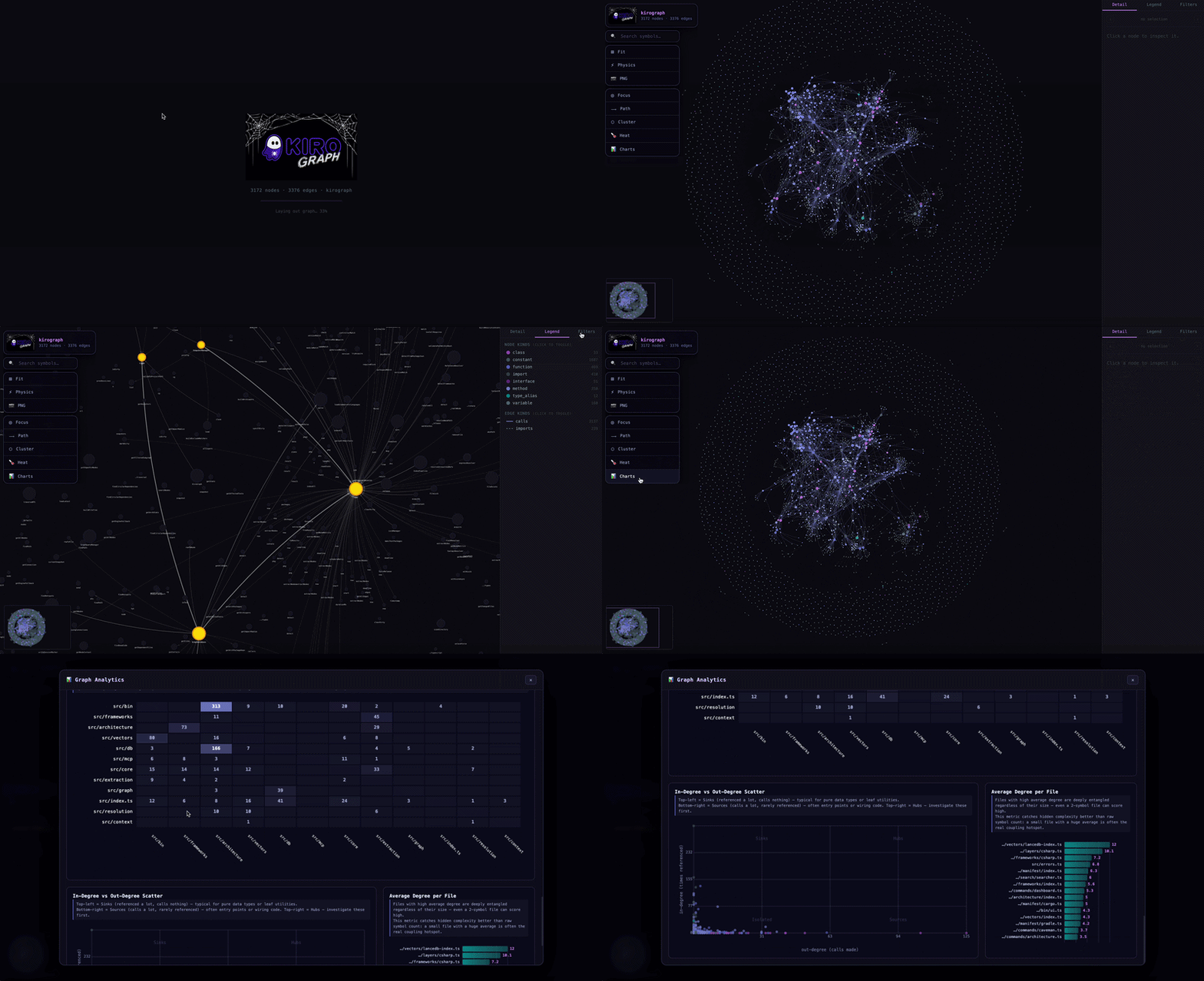
When semanticEngine is set to qdrant or typesense:
kirograph dashboard start [path]   # Start server and open dashboard
kirograph dashboard stop [path] # Stop the running engine serverkirograph serve --mcp # Start MCP server (used by Kiro)
kirograph serve --mcp --path /my/project # Specify project path